
There’s a very big problem with the new Notre Dame
The Paris cathedral has risen from the ashes of a devastating fire but something profound has been lost during its $1.4 billion restoration.


Although brilliantly sunny, it was definitely overcoat weather when I first visited the recently reopened Notre Dame. Basking in the winter light that poured in through its windows, the vast interior effortlessly swallowed up the hordes of tourists noisily jostling their way around its crypts and altars. Once again, the cathedral’s timeless beauty triumphed, as it always had, over the petty inconveniences that are the price of fame.
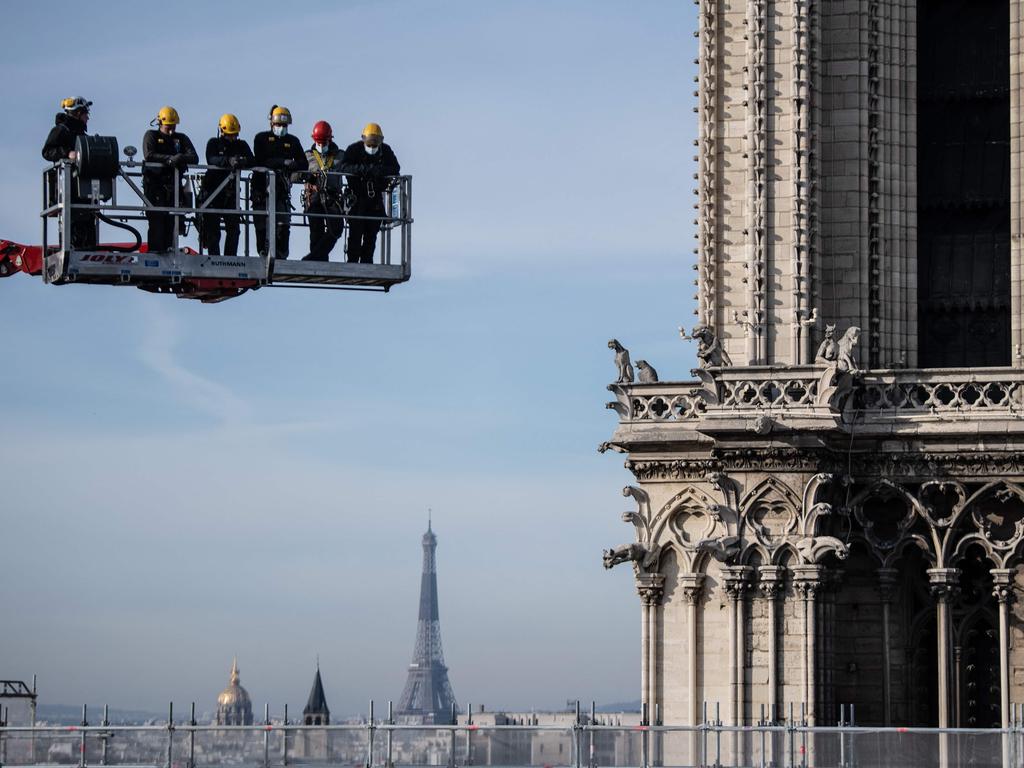
On April 16, 2019 the building had been a half-destroyed hulk, still smouldering from the fire the previous night that turned its 13th-century wood scaffolding into a blazing inferno. That it had now been so magnificently restored seemed nothing short of miraculous.
It was, after all, merely 24 hours after the fire, just as the initial, highly preliminary damage assessments were getting underway, that President Emmanuel Macron promised to rebuild Notre Dame within five years. The fact that his promise had been met, despite the task’s enormous scale and complexity, only made the achievement all the more extraordinary.
I knew, of course, that France’s great Gothic cathedrals, whose innermost structures were constructed with thousands of medieval oaks, were extremely vulnerable to fire. Nantes’ cathedral of Saint Peter and Saint Paul, a gem of the late Middle Ages, had gone up in flames in 1972 – and because the flammable materials were so deeply set in its walls and ceilings, a restoration aimed at reducing the risks failed to prevent another major conflagration in 2020.
But Notre Dame, squatting defiantly on the banks of the Seine, exuded a solidity that seemed to place it beyond the ravages of time and fate. This, for anyone brought up on Victor Hugo’s The Hunchback of Notre Dame, was where Quasimodo, whose monstrous form belied the warmth of his heart, and the beautiful, wild Esmeralda, fell victim to the dark designs of Claude Frollo, a scholarly alchemist driven to madness by jealousy and lust. What could better counterpose the sleek, but spiritually vacuous, machine age vanity of the Eiffel Tower than the monumental stone towers that had witnessed that heart-wrenching story, just as they had, for so many centuries, mutely kept watch on the city’s triumphs and tragedies, successes and catastrophes?
Little wonder then that the sense of irrecoverable loss, when the images of the blaze first flashed across our screens, was so overwhelming. So was the public response, with contributions flooding into the hastily established reconstruction fund. It would, however, be a serious mistake to think that Notre Dame had always been dear to the Parisian heart. In effect, Hugo’s decision, in 1830, to write his great novel was driven by sheer desperation. The building he considered “the ancient queen of our cathedrals” appeared doomed to fall into ruins. And not for the first time.
Extremely perilous
In 1526, when Notre Dame was about to celebrate the tricentenary of the pealing of its bells, the master architect Jean Lagrippe described its condition as extremely perilous. By 1756, the stained-glass windows had to be removed, as shards flew at the congregation whenever storms buffeted the building’s exterior. Only the cathedral’s splendid roses remained intact, and even they were threatened. To cap it all off, the spire had to be demolished in 1793, as it was in the throes of collapse.
The French Revolution added deliberate harm to the damage wreaked by neglect. Initially, the vandalism was limited to destroying every vestige of the monarchy. But once the Revolution’s anticlerical phase got into full swing, statues of Christ and the Virgin were replaced by busts of the great philosophers, while the rood screen, an ornate partition between the chancel and the nave, was dismantled so as to make room for a monument to Liberty and Reason.
The cathedral in which Napoleon had himself crowned emperor on December 2, 1804 was therefore in serious difficulty – and with the regime focused on its disastrous military adventures, the only repairs it undertook were cosmetic. Nor did the situation improve after that.
No doubt, financial constraints played a part. The crucial factor,however, was the widespread view that Gothic architecture was not worth preserving. Giorgio Vasari, the founding father of European art history, had set the tone in his 1550 work Lives of the Most Excellent Painters, Sculptors, and Architects. Contrasting what he considered the unseemly chaos of Gothic churches with their Renaissance successors’ elegant symmetry and simplicity, he described the style as befitting barbarians – hence its name, which linked it to the Goths’ sack of Rome in 410. By the middle of the 17th century, “Gothic” had entered the French language as a synonym for “misshapen”, “inept” or “monstrous”. Even the 18th-century “erudits”, who began the process of carefully documenting the medieval cathedrals dotted around Paris, viewed them as embarrassing relics of a deeply unenlightened age.
To make things worse, the style’s first defenders were Germans, whom the French considered scarcely more civilised than the Goths. Johann Wolfgang von Goethe’s passionate 1772 essay Von Deutscher Baukunst (From German Architecture), written on the 21-year-old writer’s arrival in Strasbourg, brimmed with praise of the style’s “grandeur”, which, Goethe (fancifully) argued, reflected its authentic Teutonic roots. Triggering one of German nationalism’s periodic bouts of fervour, Goethe unleashed a Gothic revival that culminated, from an intellectual point of view, in Georg Wilhelm Hegel’s rapturous description, in his Lectures on Aesthetics, of the cathedrals as havens of “grandeur and sublime peace”, blessed with a unique capacity to elevate the human spirit “above anything purely utilitarian into an infinity in itself”.
All that could easily have entrenched the French hostility to the country’s Gothic landmarks. But the Revolution’s violent anticlericalism, and its scorn for the achievements of the ancien regime, set the seeds of a change in attitude. No one was more influential in that respect than François-René, vicomte de Chateaubriand, whose Le Génie du Christianisme (1802) glorified, in prose of haunting lyricism, the “misty feeling of divinity”, the “shiver”, the towering cathedrals evoked.
The cathedrals, Chateaubriand claimed, were designed to recreate the beauty and terror of the forests in which early Christians worshipped. Their complex vaulting mirrored the lines of intertwined branches, while the monks’ chants funnelled into the present “ancient voices from the heart of the stones, in sighs that echo from corner to corner of the vast basilica”. As for the brilliant light cast by their stained-glass windows, it conveyed the splendour of the morning rays piercing the sombre majesty of dark, deep woods. In short, far from being monstrosities, the cathedrals were the legacy of an “age of magic and enchantment”.
The Victor Hugo effect
It was largely Chateaubriand’s elegiac lament that transformed the young Hugo into an ardent advocate of architectural conservation. The Hunchback of Notre Dame, which was issued to vast acclaim in 1831, captured the public mood; to cement its impact, Hugo engaged in incessant advocacy, most famously through an article, published in 1832, that called on the government to enact a law preserving “the only thing nearly as valuable as a country’s future; its past”. Three years later, when the Commission on Arts and Monuments was set up, he became a founding member, serving for 14 years as its most effective and energetic publicist.
In that way and others, Hugo’s efforts were instrumental in causing the government to issue, in 1842, a tender for Notre Dame’s comprehensive restoration. Reflecting the spirit of the liberal, modernising reign of Louis Philippe I, the task was assigned to two young architects, Eugène Viollet-le-Duc (1814-1879) and Jean-Baptiste Lassus (1807-1857), who had proven their talent with the restoration of the cathedral at Chartres and of Notre Dame’s glorious neighbour, the Sainte-Chapelle.

Unfortunately, France’s financial and political turmoil kept the work largely on hold until 1853, when Lassus was terminally ill. It therefore fell to Viollet-le-Duc to single-handedly design and manage the restoration. One of the century’s most brilliant architects, he tackled the challenge with indomitable Cartesian rationalism. Virtually inventing the terms that are now used to designate the component parts of Gothic cathedrals, Viollet-le-Duc explained his philosophy of restoration in his Reasoned Dictionary of French Architecture, where he argued that “to restore an edifice is not to maintain, repair or rebuild it; it is to re-establish it in its complete or essential state, which it may never have previously fully attained”.
It was, in other words, the restorer’s role to bring to fruition the “vital idea” the edifice embodied – that is, the animating spirit of the Gothic. That did, to some extent, involve conservation, narrowly defined. In particular, Viollet-le-Duc had Notre Dame’s superb roses dismantled, cleaned and so perfectly and firmly reassembled that they survived the catastrophic fire in 2019.
However, in his quest to give form to the Gothic’s underlying ideal, Viollet-le-Duc went well beyond mere conservation, reshaping the cathedral itself. A layer was added to the nave; new sculptures were commissioned and old sculptures rearranged; and most famously, a completely original, extraordinarily tall and ornate spire was built, while the fantastic, chimerical aspects of the cathedral’s external iconography were vastly expanded.
That the changes, which became apparent when the cathedral was reconsecrated in 1864, were controversial was scarcely surprising. John Ruskin, whose essays had done so much to rehabilitate Gothic architecture, roundly condemned them, declaring that “Notre Dame no longer exists for me”. Writing in a Parisian paper, a leading French critic lauded Viollet-le-Duc but concluded that the cathedral was now “a masterpiece of 19th century architecture”, rather than remaining the first 13th-century structure built entirely in the Gothic style.
Had Viollet-le-Duc gone too far? Where is the boundary between restoring and building anew? The debate, which continues unabated into the present day, is probably unresolvable, involving as it does matters of degree. But its enduring merit, and contemporary relevance, lies in having stimulated a far-reaching clarification of Gothic architecture’s essential nature.
The outstanding contribution was by Émile Mâle, whose Religious Art of 13th Century France (1899) both synthesised and enormously advanced the study of medieval architecture. The structuring principle in his analysis was the concept of the Gothic cathedral as a speculum or “mirror” that shines into the worshipper the splendour of God’s creation. Ordinary mirrors show things as they are; the Gothic specula show them as they ought to be. A hinge that links the invisible upper world, that is, the Divine, with the visible lower world of mundane humanity, the cathedral is a mirror that allows the congregation to transcend the profane by catching a glimpse of the sublime.

What is at the heart of that effect is not the edifice itself. The cross-ribbed vaults, pointed arches and flying buttresses are, for sure, stunning feats of engineering. As Robert Mark put it in his classic High Gothic Structure (1985), “we stand in awe of the achievement of the Gothic builders”, who could precisely estimate the required length of the flying buttresses, “when we consider that Galileo, centuries later, could not correctly even describe the bending stress distribution in a simple beam”. But those engineering achievements were, the eminent German art critic Otto von Simson pointed out, “constructive means, not artistic ends”. The end, which made the Gothic entirely different from its predecessors and successors, was to design a structure that soared towards the heavens and yet was sustained by exterior walls “pierced by continuous rows of windows”. As a result, the building itself would ultimately appear as “a shallow transparent shell” around the nave, while the windows would “seem to merge, vertically and horizontally, into a continuous sphere of light, a luminous foil behind all tactile forms of the architectural system”.
This was, in other words, a design entirely oriented to the exaltation of light, which determined the orientation of the cathedrals – they were, again unlike their predecessors and successors, invariably oriented from east to west – as well as the positioning of their sacramental elements. The morning light, rising in the east, pointed to Jerusalem, symbolising renewal, while at the western end, where facades carried representations of the Last Judgement, the setting Sun illuminated, with terrifying clarity, the world’s last evening.
The emphasis on light was readily understandable in an age where lives were largely spent in darkness. Ordinary candles, even when densely stacked, were less luminous than today’s dimmest light bulbs; in almost all towns and villages, the risk of fires meant that most forms of illumination were prohibited at night. To bask in the concentrated radiance that shone through the multicoloured windows of Gothic cathedrals would have been an experience that transcended mundane life.
However, that experience also had a profound theological underpinning. In the theological system recorded in the text known as Theologia Mystica, which was absolutely central to the conception of the cathedrals, God is presented as the initial, uncreated light, the origin of all creatures. The source of light, God – who is invisible by essence, incomprehensible by nature – cannot be seen; yet the light can, irrigating the world in a vast luminous splash that cascades down to the lowest level of creation. By praying wrapped in that light, every creature unveils, to the extent that it can, the splendour of God – that is, the truth.
It was therefore no coincidence that when the rebuilt Cathedral of Saint-Denis, which effectively launched the Gothic era, was consecrated, the verse the choir chanted from the breviary was “All thy walls are precious stones”. Like “shining gems”, said the cathedral’s great architect, Abbot Suger, the “reciprocal coupling” of otherworldly and this-worldly light admitted through the sacred illustrations in the stained glass would instantiate the lux nova, or new light, that was Christ.

But that effect relied not just on the light but on the contrast between the windows’ luminescence and the dense gloom of the cathedral’s interior. It was not light alone, but the interplay of light and darkness – what Suger referred to as “bright-dark brilliance” – that conveyed the abject reality of sin on the one hand and the hope and promise of redemption on the other. Indeed, in Dante’s Divine Comedy, which is pervaded by the medieval theology of light, it is only in the Empyrean, or highest reaches of heaven, that vision, freed of all human limitations, can withstand the “pure light” that exists without darkness. And the price it pays for seeing that light is to have abandoned mortal life itself.
Dark and light
Never is the effect the architects of northern France’s great cathedrals sought to achieve more vividly realised than in autumn and early winter. That is when one feels, almost physically, the shortening of the days and the transitions from light to darkness. The cathedrals “work” superbly at that time, as the slight chill created by the nave’s sheer size is cut by the flickering warmth of the refracted light from the windows. The “soul of the Gothic”, wrote Ruskin with his customary elegance, is shaped by the light of the north filtered “through clefts in grey swirls of rain-cloud”. Here is the “benignity of sunshine” miraculously piercing a gloom the Mediterranean’s “ceaseless sunshine” can’t know. And if Monet’s Cathedral series is an unrivalled masterpiece, it is because the play of autumnal light and rain on the facade so perfectly captures a “soul” utterly alien to climates where the days are incessantly bright.
For centuries, that duality of light and darkness, sin and redemption, was inescapable in the Gothic cathedrals. The soot from their giant candles, which on feast days were 2.5 metres high and weighed up to 100 kilos, enveloped the interior in a shroud of darkness. The walls were rarely cleaned; and even when they were, black was merely reduced to a dark shade of grey. To see the light stream in from on high was to be reminded of what was meant by sheer beauty.
So it still was, more than 50 years ago, when I first visited those monumental structures. Yet that is no longer the case at Notre Dame. Newly washed and painted, its internal walls gleam, at times glistening; gloom, it seems, has been banished. And the light, even from the roses, is no longer an imminent force, perspiring through the stone, caressing the cathedral with its presence. Rather, it resembles the pure physicality, the irreducible “thingness”, of contemporary light sculpture, in which, as the poet Wallace Stevens suggested, lasers project a focused beam of unbearable brightness that “adds nothing, except itself, to reality”.
But a cathedral in which there is light without darkness is like a world that has turned its back not just on faith but on human fallenness and fallibility. No one would have felt that more keenly than Sigmund Freud, who, on entering Notre Dame in 1885, stood “deeply lost in wonder”, gripped by “a sensation I had never had before: I had never seen anything so movingly serious and sombre”. Spending there “every free afternoon”, the Catholic cathedral, with its juxtaposition of light and darkness, good and evil, transience and eternity, brought home, to that quintessentially secular Jewish intellectual, the duality between overpowering instinctual forces and the quest for self-control that he would eventually place at the centre of his life’s work.

Ever since his first trip to London in 1875, Freud had admired the English as models of ethical rectitude, puritanical rigour and the rule of law. Later in life, he named all his children after his teachers or their wives – except one, Oliver, his second son, who he named for Cromwell. But Paris, and especially Notre Dame, focused his reflection on the perpetual, uneasy conflict between those virtues and our desires, passions and weaknesses. And it drove him to recognise the harm, to individuals and society, that ignoring the reality of our humanity could cause.
Perhaps that age, which could gaze with wonder at the light of redemption, has passed. Victor Hugo certainly feared its end was coming. In a famous chapter of The Hunchback of Notre Dame, he speculated that printing, for all of its enormous merits, would fuel forces that undid the cathedral’s magic. Thirty years later, in the historical novel Ninety-three, he warned against a swelling tide of fanaticism that would destroy both the library and the cathedral, leaving structures that remained in place but that were “deserted, spiritless, dead”.
And Marcel Proust, writing in the first decades of the 20th century, echoed those concerns. The danger, he said in the last volume of In Search of Lost Time, whose publication he supervised, is not that the cathedrals will crumble; it is that once we “renounce their truths” we will no longer understand them. Yes, buildings can be restored, renewed, rebuilt; ultimately, however, what matters is our capacity to make sense of, and enter into silent dialogue with, “stones whose beauty comes precisely from having captured, for a moment, human truths”.
None of that detracts in any way from the phenomenal work that was done in bringing the “ancient queen of our cathedrals” back to life. Nor will it stop the hordes of tourists from descending. This year Notre Dame will, it seems, host as many visitors as the Louvre, whose surface area is ten times larger. But I, for one, hope that they will pause for a few minutes to think of those who, in earlier days, humbly stood where they now stand, bewitched by the gemlike splendour of the light, the radiance of the Sun and the plenitude of our days.

To join the conversation, please log in. Don't have an account? Register
Join the conversation, you are commenting as Logout