
Philippa Nikulinsky is world-renowned for her botanic art.
For almost six decades, 83-year-old Philippa Nikulinsky has trekked through Australia’s harshest landscapes to paint its most resilient plants - but don’t expect to see her work in our major galleries.

For a plant, nothing is more critical than the punt taken by its first root. One thread, slim as a hair, must anchor a seed that has drifted to earth – fallen, fluttered, floated, perhaps glided on the wind, hitched itself to fur, been born of fire, or, of all indignities, been spattered out the back of a bird. The seed will now live or die. No chance to find a home less cold, less dry, less dangerous. No escape from drought, storms, frost, foraging insects and hungry wildlife.
A lucky root will find moisture, and for one brief, glorious moment, nature is alive with possibility. And maybe, just maybe, this plant will have a beautiful life.
Philippa Nikulinsky’s creative life is rooted among some of the most arid landscapes on Earth. For almost six decades, the 83-year-old has been drawing and painting the survivors of harsh and hostile environments – and where better to find them than in the deserts and scrub plains, the eucalypt woodlands, ironstone ridges and red dirt of the West Australian outback. The creator of exquisite paintings of native flora, she is considered one of Australia’s finest wildlife artists, painting in vivid watercolour with forensic attention to detail. In her field, she is considered irreplaceable.
No plant is too unlovely, no tree too disfigured to capture her rapt attention. She sees beauty in endurance: in coarse spiny leaves, razor-toothed leaves, and leaves that look like droopy moustaches; in flowers with brilliant streaks and veins, with ruffles, with pleats, with puffballs as big as fists or petals as small as baby’s fingernails, smelling of honey, grass, citrus, cinnamon, or of nothing but the pulse of the sun.
“Nature is chaos in motion,” Philippa tells me. “A month after a flood, all these scraggly shrubs have sprung into life, covered in flowers, and I say to them, ‘Oh, aren’t you so beautiful! How have you survived here?’ I’ll walk over bushland, see a plant and ask it, ‘Why are you like that? What on earth happened to you?’” Her eyes brim with emotion.
“I know, I know,” she says, gulping back her tears to laugh. “I talk out loud to them like children. But I want to be able to engage someone else in that wonder. I need my paintings to have what I call ‘the full catastrophe’, the whole story of a life lived – the old, the new, the dead, the bird’s nest and insect damage. I owe it to the plant to do the best painting I can. That’s not always a thing of beauty, you know. I’m recording what the plant did in its time on this Earth.”

At exhibitions, her ability to astonish people with the wonder of plants can move viewers to tears. “It has taken me a long time to understand why people have such big reactions to my work,” she says. “I think it’s because flowers, birds, trees are memory jolts from happy times, of wildflowers you once picked, or a tree you remember from a granny’s garden. They’re a vivid reminder of our universal human love for the plant world.
“Maybe Australians have a particular love for their land – especially now, when there’s so much ugliness in the world – but people will come up to me at exhibitions and ask if they can hug me. I think they’re overwhelmed by the passion in the drawing.”
She is a storyteller of the natural world: of adaptations forced by distress and deprivation, of regeneration after fire, of resurrections after drought. “That’s why I like to go to remote places to draw them – because while most of the plants I paint can be watered and fed and coaxed to thrive in a suburban garden, I want to see them growing where life hasn’t been made easy for them.”
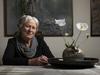
Philippa Nikulinsky’seyes are cornflower blue, her cheeks round and flushed, her long silver hair gathered, as usual, at the nape of her neck. She is small and sturdily put together, a survivor herself of 83 fierce West Australian summers and the demands of raising four boys with her husband of 65 years, Alex.
Alex, 87, is tall, skinny as a stick and sharply handsome, with a mop of white hair and whiskers. “She sure knows how to get her way,” he tells me with a wry smile. “But I love that feistiness about her. On field trips I’ve learnt to walk ten paces behind her, much like Prince Philip trailed behind the Queen.”
They’ve lived in the same house for 60 years, a 1930s brick bungalow squatting among the mansions in swanky Dalkeith, a Perth suburb flanked on three sides by the Swan River. At the bottom of their garden, shaded by a towering plane tree, is her glass-walled studio – or, as Alex refers to it, “the salt mines”. It’s where she spends up to eight hours a day, seven days a week, in furious concentration at work.
“I can’t procrastinate,” she says. “If I have something on the board I’m just at it for hours. It’s in my head all day, then I lie in bed at night before I go to sleep thinking, ‘Would that look better if I extended that branch?’ And I can’t work if anyone’s in the room.”
Alex raises one eyebrow and shuffles backwards towards the studio door. Philippa rolls her eyes and laughs.
She is seated at her drawing board, with the accoutrements of a painter’s life around her: pigment, palettes, hot-pressed paper, vases crammed with brushes and pencils, watercolour pans filled with dozens of bright cakes of paint. Hanging low, eight tubes of daylight-adjusted fluoros flood her desk. A magnifying glass on a bent metal elbow waits to be needed.
Watercolour painting is notoriously difficult – so much depends on directness, speed and the certainty of intention. “Every stroke you put down you have to go with,” Philippa says. “Anything tentative or fumbling ends in disaster.”

The paintings she produces are valuable: larger works might fetch $20,000, and a collection up to $300,000. Her largest works, those she calls “story rolls”, can be over five metres long, take years to produce and cover whole ecosystems of plants, birds and insects. They are highly sought after by international buyers and sell for up to $50,000.
“Genius” is a risky word to apply to an artist: unlike attaching it to a mathematical or musical savant, artistic talent is as mysterious a gift as it is miraculous. The mythology surrounding Philippa Nikulinsky springs from her staggering work ethic and her ability to fire the imagination of her audience. She’s been known to travel 2000km to draw a single specimen. “I went back to the East Pilbara three times in three years to paint this one Grevillea pyramidalis [tree]. I was sure it was having its final flower. I desperately wanted to paint that massive flower head, those hundreds of tiny flowers on a colossal triangular spike. Even now,” she says, pointing to the finished work, standing over a metre high, “I never get bored of looking at it because so much of me went into it.”
“Why be seduced by the outliers?” I ask.
“Oh, their mystery, I suppose, their transcendence, their unknowability.” She shrugs and smiles. “I love them because they have character. They are evolutionary experiments.” She motions to a pagoda of field drawings at one end of the vast jarrah table in her studio.
“Our flora is very difficult to paint because many of them are covered in hairs and spines and thousands of flowers in one cluster, which can take an awful long time to draw. Every painting requires a set of field drawings. I do the drawings in the bush while I have the plant fresh in front of me. I use a big lens and photograph them as well, so I have the habit of the plant. I might have 30 or 40 field drawings for one painting in the studio.”

Philippa is not a botanist, a geographer or a natural historian, but her works inhabit the intersection between science and art. “There are many, many painters better than me,” she says with an oblique smile, “but I’m not trying to be like other painters. If I do get a commission – and frankly, I don’t like them because it means I’m beholden to someone else’s ideas – I say I have to have total control or I won’t do it. Twenty-five years ago I took every offer because we needed the money. Now I’ll reject the ones I don’t like.”
I note the steely undercurrent in her voice when she adds: “I set the price and I’m not negotiable. That’s a feminist statement.”
Our conversation swerves around a blind corner. “I’ve had critics at my exhibitions say, ‘Why on earth are these paintings in an art gallery?’ Or they’ll sigh and say, ‘Oh look. Flowers. Lots of flowers. This isn’t art. This is just another little old lady in a felt hat killing time’.”
I see her colour rise. “That really gets my goat. Art is the last bastion of misogyny. Have you seen many blockbuster exhibitions of women artists? No. And if you have, I bet they’re dead. I tried to get a funding grant once and they wouldn’t give it to me. When I asked why, they said, ‘Because what you do isn’t cutting edge.’ Well, all the Dutch masters painted flowers and that was cutting edge, wasn’t it?”
Alex pipes up: “They were different flowers.”
I’m too scared to laugh.
Philippa cites the example of Lee Krasner, an American pioneer of abstract expressionism in the 1940s. “Even 25 years after her husband’s death, she was continually referred to not as a leading artist in her own right but as ‘Jackson Pollock’s widow’. It wasn’t until after he died that the true worth of Krasner’s art came out.”

Modern critics have long questioned the absence of women from the canon of Western art. Throughout history, female artists faced institutional obstacles: no admission to life drawing classes; no apprenticeships in large studios; no easy hobnobbing with patrons; no access to prizes or residencies, or even paint in some cases. Many had their works falsely attributed to men. And the bias continues into the 21st century. Of the $196 billion spent at art auctions between 2008 and 2019, only $4 billion, or 2 per cent, was spent on works by women artists. What’s more, their pieces sell for a fraction of the prices received for comparable works by male artists. In 2013, German painter Georg Baselitz said he knew why: “Women don’t paint very well,” he told the news magazine Der Spiegel. “It’s a fact. The market doesn’t lie.”
Says Alex Nikulinsky: “I’m proud that Philippa won’t tolerate being bullied by male critics. She will not let anyone tell her what to paint or how to paint it.” In 1993, Alex quit his career to champion his wife’s artistic practice. Then aged in his mid-fifties, and with all four boys still at home, he left his job as a statistician at the Bureau of Statistics “to dedicate the rest of my life to an important woman artist who happens to be my wife”.
He tells me out of Philippa’s earshot: “I didn’t want her going bush on long field trips having to manage everything – the truck, the tent, the weather, the dangers of remote country. I was happy to hold the fort at home if she needed. I went with her if I could, but I wanted her to blaze her own trail and I feel a deep sense of satisfaction at her achievement. I see how West Australians embrace her as their own. Her paintings are so much more than a plant with a long name. They’re a rare portrait of a very particular plant and an extremely valuable study of place. And I’ve never regretted putting her career ahead of my own for a second.”
Their love story is a study in symbiosis. Philippa grew up in Kalgoorlie, surrounded by the slime dumps and slag heaps of a town built on dreams of gold. The headframe of her father’s mining lease, The Enterprise, obliterated the view from her bedroom window, and the clangour of the mine – its winder bell, the crash of ore hitting the bins, trucks grinding in low gear – became the soundtrack to her childhood.
As far back as she can remember, she was drawing at a bench in her mother’s pantry, sometimes with a hanging leg of ham for company. Scrounging for art supplies, she was winning competitions at 12 and knew she wanted to be an artist. “I did a lot of riding off on my bike to explore the bush, bringing home flowers to draw. Mum and Dad couldn’t afford to send me to art school so I went to Perth Teacher’s College instead and did a couple of art units at night school – the only formal training I’ve ever had.”

On the beach at Cottesloe, aged 18, she met a boy with “luscious legs”. Alex remembers being mesmerised by the girl who was “so glossy” he knew he was done for. They were married a few months later, and Philippa was soon pregnant. “My mother wore dark glasses for a year,” she says.
Thirteen months later, there were two babies and Philippa was barely 21. Money was tight, with Alex studying economics and working as a postman on the side. Philippa began designing and making wedding dresses to earn extra cash. “I used to sit inside the playpen with the sewing machine and let the kids have the run of the house. Dangerous way to work,” she chuckles. “Then I got pregnant again. See the common theme here?” Her laugh is loud and generous. “We had to borrow the deposit for this house. My mum sighed and said, ‘Champagne tastes on a beer budget.’ But we’ve never looked back. Alex wanted his kids to have a steady home base because he’d been to 14 schools by the time he was 11. He was a Polish refugee, moving through camps across Europe until his family docked at Fremantle, and he taught himself English from Little Golden Books.”
In 1969, with three boys under seven, Philippa began painting again. “A neighbour said, ‘Why don’t you put something into the Red Cross Art Show at the local hall?’, and they all sold. I couldn’t believe it. Even now I can paint almost anything and people seem to love it. I think I found a niche in the market.”
Right now Philippa is working on a painting of an Eremophila, a desert flower she sketched while camped in WA’s vast Great Western Woodlands. “This woodland had had no rain for four years and here were all these little flowers pushing up on dead twigs. They captivated me. I’m not painting flowers, I’m painting determination.”

She and Alex have just returned from a month-long field trip in the Die Hardy Range, a 35km stretch of iron cliffs, caves and rock formations seven hours’ drive from Perth. The couple travel in convoy with 380 litres of water and all their meals pre-cooked and stored in jars. Says Philippa: “We drive one 4WD each. I tell Alex it’s for safety reasons, but really it’s for my sanity. He has the radio up so damn loud.”
Alone or with Alex – her trusted photographer – Philippa has been going bush for almost half a century, sometimes visiting places 100km from the nearest human being. “In the old days we had no GPS, no radios – but I haven’t had any close calls because Alex is so good at planning and he can fix anything. One trip I remember being so struck by the intense heat, I was pouring water over my head and clothes and all the bees came and sat on me sucking. One went between my toes and I thought I was very brave for sitting stock-still while it drank.”
Philippa reckons this winter’s field trip may be her last: “We had three weeks of terrible weather. Freezing cold in the morning with ice on everything, sideways rain, lightning strikes and winds so fierce they blew away our shelter and every tent peg pulled out. We endured it,” she says with a grimace, “because the bush was so lovely and there was so much material for me to draw. But I gotta say, when everything’s wet, you’ve got no heating, you’re not allowed a fire because you’re in a national park and you’re 83 and 87, it gets harder and harder to sit and draw in the cold and damp – not to mention getting out of the back of the truck in the middle of the night to have a wee.”
For Philippa, slow bushwalking is soul food. Head down in close observation, she becomes almost part of the cycle of nature itself. “It’s so wonderful to watch things bud and flower and fruit, all in real time. One day I sat in front of a flowering shrub for nearly a whole day and watched everything that came to that shrub – the ants and wasps, the thornbills and western fieldwrens … it’s the reward of having time to see life growing in one place. And to be able to honour that day in the plant’s life is my privilege as an artist, because the best way to understand something is to draw it. We camp in one place for five or six weeks. Or until I want a bath.”

She keeps meticulous diaries of each day’s adventures, not only an evocative history of her life but a record of her discoveries, including a new species — a dwarf kangaroo paw, Anigozanthos gabrielae, whose seed is now stored in the Svalbard Millennial Seed Vault in Norway.
When I ask whether she believes global warming is the biggest threat to our flora, she shakes her head: “No. It’s mining. And I come from a mining family. I’d like to be more optimistic. I’d like to think that Alcoa won’t keep mowing down our jarrah forests. But that company has had the lease over the whole of the Darling Range since 1961. They own it. I suspect it’s a lost cause. Big business wins every time. And I know big businesspeople will read this and they won’t like me.”
“Do you care?”
She snorts. “Nope. I look at my collections from the 1990s of all the biogeographical regions of WA and I now realise those records will be all that’s left of some of those places. Especially in the intricate details of the plants there. WA has a dreadful history of extinctions and they’re all man-made. So many plants lost. And this is what really bugs me: I have to get a licence to pick a single plant, and yet mining companies come in and bulldoze massive haul roads right across pristine landscapes. We lose whole species to those giant operations, and yet I’m not allowed to take a cutting? It’s so wrong.”
For a girl whose childhood home, bush backyard and neighbourhood streets have all been swallowed by the Super Pit gold mine, Philippa is surprisingly optimistic about how man and plant should share the Earth. “Nature has its own villains,” she says. “Dieback fungus is everywhere. We’re losing banksias, hakeas, grevilleas, eucalypts. I have noticed dramatic differences in quite a few places in the last half century, but until climate change became a thing I looked at it more as cycles: drought, flood, fire. Drought wreaks the most havoc on plant life. A plant will contort itself to stress, drop leaves and branches, adapt and change and suffer, but I’ll spot a tiny speck of green and feel hopeful that everything will be alright.”
Her eyes mist again. “I know how lucky I am to have been given this gift of a steady hand, a good sense of line and colour and an eye for wonder. If I can still draw two parallel lines very finely together at 83, I’m incredibly grateful, and I’ll keep painting our flora as long as I can.”
She pauses before adding quietly: “But I think I’m running out of time to paint them all.”
I’m a bit teary myself to think old age might catch up with this hardy specimen, whose ability to educate, and to amaze, has made her a national treasure. After four hours in her studio, as I push back my chair to stand, I ask, “Is there anything you won’t paint?”
“White flowers,” Philippa says without missing a beat. “I look at them and say, ‘Yes, you’re really beautiful, but you’re an absolute bugger to paint’.”

To join the conversation, please log in. Don't have an account? Register
Join the conversation, you are commenting as Logout