
No act of forgiveness can reverse truth of October 7
In my world the task is not to forgive but to accept, to bear witness and to demand justice.

At the memorial service for Charlie Kirk on Sunday (Monday AEST), in an American stadium filled with thousands and lit with fireworks, Kirk’s widow, Erika, stood before the crowd and spoke.
Her words rang out in that vast space of amplified grief, reverberating across television screens and the news cycle: “I forgive him. I forgive him because it was what Christ did. What Charlie would do. The answer to hate is not hate. The answer we know from the gospel is love and always love. Love for our enemies and love for those who persecute us.”
The crowd wept. Commentators praised her courage. America applauded.
And when I heard her say, “I forgive him,” something collapsed inside me. Why does forgiveness always arise in the face of murder? The murderer did not ask for forgiveness. He did not repent. He did not seek reconciliation. Yet the question hangs in the air as if inevitable: Will you forgive?

Christianity has made forgiveness not only a moral imperative but, in its theology, a divine calling. When Christ said, “Father, forgive them, for they know not what they do,” he spoke from the cross, suggesting that those who killed him acted out of ignorance or moral blindness, unaware of the full weight of their actions. They were, in a sense, like children lacking agency, unable to grasp the cosmic consequences of their deeds.
Forgiveness, in this sense, is an extension of grace: not condoning the act but recognising the perpetrators’ moral deficiency. To forgive the unforgivable is to meet ignorance with love, to interrupt the cycle of hate with radical mercy.
But in my world, with Maya, a 25-year-old victim of the Nova music festival massacre on October 7, 2023, that framework collapses. There was no ignorance. No innocence. The killers knew exactly what they were doing, calculated and methodical. Here, the language of forgiveness feels hollow, even impossible. The task is not to forgive; it is to accept, to bear witness and to demand justice.
Acceptance, because there is no undoing it. We cannot change it. We cannot wish it away. We can only bear it. It is not acceptable, yet it is real. It is unbearable, yet it is the law of life. Life is always measured against death, just as light is measured against darkness.
No act of forgiveness can reverse that truth.
When I travelled to Israel two weeks ago, I believed I was going simply to bear witness for a documentary on anti-Semitism in Australia and to gather context for the exhibition I am curating for the Goldstone Gallery in Melbourne, October 7: Atrocity, Antisemitism, and Resilience. I thought I would observe from a distance, hold space for testimony and return with material to inform my work.
But the reality was different. What I encountered broke through every layer of protection I thought I had. I didn’t just gather stories, I carried them inside me. I came back with a wound that is also a responsibility, a knowledge that cannot be set aside.
The deaths of more than 1200 people in a single day and the ongoing captivity of 48 hostages are impossible to truly grasp. Numbers blur into abstraction. So, I want to tell you about one person. One life. One name. To remember one is to resist letting the massacre dissolve into statistics. By pure chance, that person is Maya Puder.
Maya Puder. Born November 26, 1997. Daughter of Ayala and Avi. Sister to Eliya and Halelli. A young woman of piercing blue eyes and irrepressible laughter. A first-year film student at Tel Aviv University, drawn to stories and the magic of cinema. She loved music, dancing, travel, simplicity. “Just live. Just be. And lighten up,” she would say.

And then she was gone, murdered at the Nova music festival, alongside hundreds of others who had come only to dance.
I sat with her mother, Ayala, at the Nova festival site, surrounded by a forest of gum trees. A new plantation of 418 young gum trees had been added, one for each life taken. Among them, Maya’s face looked out. Ayala carries her grief not with bitterness but with quiet, immovable dignity. She spends her days guiding strangers through the ruins, telling Maya’s story, keeping her light alive.
When I asked her about forgiveness, she did not hesitate: “When I am asked if forgiveness lives within me for those who murdered my daughter, I realised that forgiveness is not where my heart rests. It is not born out of anger but out of the choice to guard my fragile strength for something higher. All the energy I have left is devoted to keeping Maya’s spirit alive.”
Not forgiveness. Not vengeance. Only the persistence of her light and the refusal to let her be forgotten.
Charlie Kirk’s funeral was a national mourning on display in a stadium, grief transformed into a collective resolve, and rightly so. The despicable act that took his life was condemned and his loss mourned on a monumental scale.
But Maya had no stadium. Her funeral was not broadcast across continents. There were no fireworks, no grand eulogies televised live. Only the dusty oval where Maya and her young friends once danced, eucalyptus trees, and the unbearable grief of those who loved her.
Many refused to acknowledge her death or her humanity. Others did not want to hear her name. Some denied her death altogether. Others celebrated it openly in Western capitals, on university campuses, chanting slogans that mocked Jewish lives and grief.
While their lives and roles could not have been more different – he a political activist, provocateur, and gun-rights advocate connected to the highest office in America, and she a young film student at a party – Maya and Charlie Kirk nevertheless share something in death. Both were dehumanised by the forces of power and prestige, both placed on the “wrong side of history” by elites.
For both, their deaths were justified or celebrated by some; at best, met with silence; at worst ignored entirely, while society moves on.

I cannot forgive Maya’s killers. I cannot forgive those who burnt, raped, tortured and murdered on October 7. I cannot forgive those who now pretend it did not happen, who wear her death as a banner of pride, who scrawl her absence into chants on campuses and at regular protests in the Australian capital cities. Forgiveness is not my language. Remembering is.
As Jews marked the turning of the year this week, 5786, the prayers of renewal were shadowed by grief. It has been a year defined by watching a war unfold, waiting for hostages and enduring the daily sting of anti-Semitism – synagogues burnt, homes attacked, cars set aflame, restaurants vandalised, creatives silenced.

This past year, I opened a gallery dedicated to standing up against post October 7 anti-Semitism, to platform silenced voices and create space for narratives being censored in the arts. I became the subject of a documentary by Walkley Award-winning director Danny Ben-Moshe about anti-Semitism in Australia, a project that unexpectedly carried me to Israel.
You might ask: why would a film about anti-Semitism in Australian arts take me to Israel? The answer is painfully clear: because October 7 is the day of rupture. To understand anti-Semitism, Jewish life and the world we inhabit now, one must confront that day.
October 7 divides time itself: life before, life after.
Everyone is implicated – those who spoke, those who stayed silent, those who mourned, those who dismissed it. Every opinion expressed or ignored, every choice to notice or turn away, is part of the story.
Until October 7 is faced honestly, until the massacre is not denied, inverted, celebrated, justified or called for again, the world cannot move forward. This can and should happen no matter what is taking place in Gaza.
Wars will continue. Hostages will remain in captivity. The truth must be acknowledged before anything else can be.
Until the world reckons with October 7, fully, honestly, unflinchingly, we cannot move forward.
We do not forgive the six million Jews murdered, or the relentless, longest history of violence against my people. We do not forgive the perpetrators. We do not forgive the world for turning away. We remember. We mourn. We testify. With time we can begin to accept.
This is why the October 7 exhibition opens at Goldstone Gallery – not as art for art’s sake but as testimony. Because anti-Semitism is an attempt to strip Jews of dignity, of humanity, to deny the right to narrate grief. To resist is to testify. To speak Maya’s name. To refuse silence.
Maya did not have a stadium. But she has us. Perhaps we can be her stadium: each of us carrying her light, her laughter, her words. “Just live. Just be. And lighten up.”
In Israel, it was as if I had stepped into a time machine. I retraced the path along the so-called Road to Death – moving from massacre site to massacre site, past memorials and makeshift graves. I returned changed. In holding my hand, Maya’s mother, Ayala, passed to me something unseen – an invisible button, a spark of memory and grief that I now carry with me.
Forgiveness in scripture, even in response to atrocities such as murder, offers a kind of remedy for what has no cure. It elevates the forgiver to a Christ-like moral stance, extending grace beyond justice and asserting a moral authority that transcends the act itself.
But for me there are no remedies, no easy answers; only bearing witness, remembering, carrying the weight of what has been done, speaking truth and demanding communal reckoning on a global scale – acknowledging Maya’s humanity in a Stadium for Maya. October 7 is not over. The wounds remain open. Hostages remain captive. Anti-Semitism grows bolder. And so, the work continues: to testify, to call for the release of hostages, to resist erasure, to plant trees where there was only ash, to speak names where there is silence. Not forgiveness. Not moving on. But carrying the unbearable into tomorrow.
Until that reckoning comes, I will not speak the language of forgiveness. I will speak the language of truth, memory and survival.
Because to live after October 7 is to accept the darkness, carry it and still, somehow, kindle light.
A landmark exhibition, October 7: Atrocity, Antisemitism, and Resilience, opens at Goldstone Gallery, Melbourne, on October 7 at dawn. At 6.29am, sirens will sound to mark the two-year anniversary of the massacre, followed by an all-day vigil running until sunset. The exhibition will run until December 17.
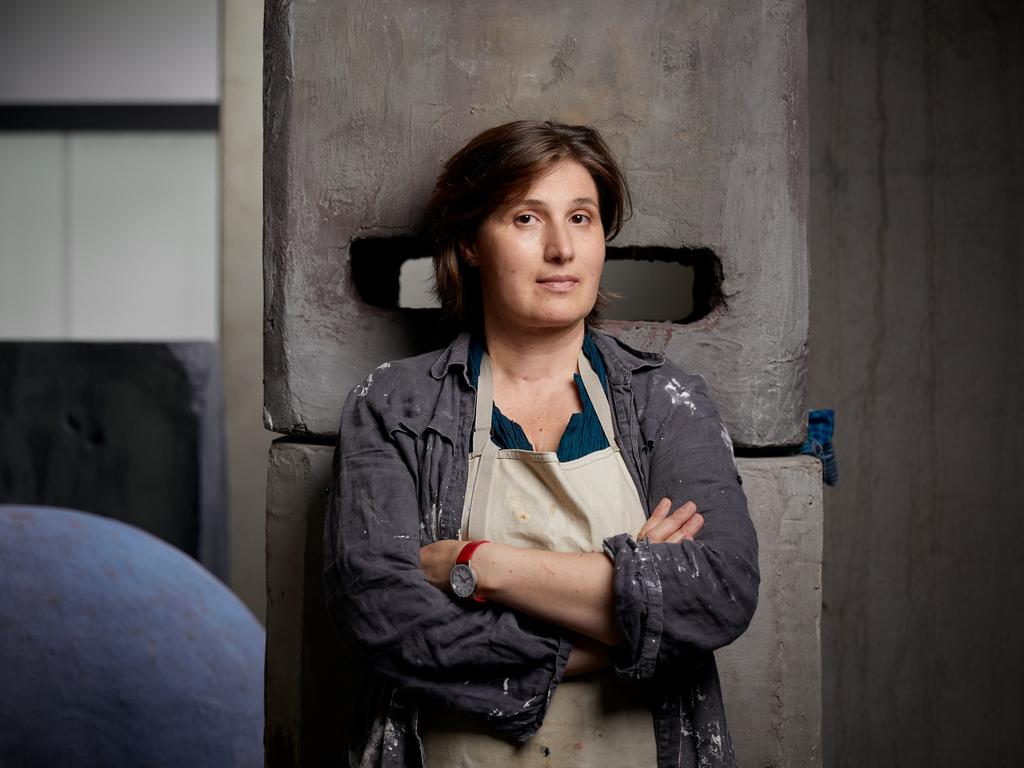
Nina Sanadze is an artist and the artistic director at Goldstone Gallery.


To join the conversation, please log in. Don't have an account? Register
Join the conversation, you are commenting as Logout