
It isn’t too late to restore Australia’s moral centre on Israel

At 81, with more than a half-century of leadership roles behind me, encompassing Jewish community causes, Indigenous human rights and empowerment, tax policy and the law, I have experienced and observed things happening around me that I never imagined I would.
I never imagined the gut-wrenching trauma of that day on October 7, 2023, when Hamas terrorists poured across Israel’s border, murdering, raping and abducting innocents in an orgy of brutality. Certainly, I would never have anticipated the almost immediate explosion of anti-Semitism in my beloved Australia.
And while I have never taken for granted Australia’s longstanding bipartisan support for Israel, my sense was that the shared values and close, multilayered ties between our two countries would endure despite inevitable differences between leaders and the governments they led.
I was born in 1943, at the height of the Holocaust, to parents who had escaped Nazi Europe, with no choice but to leave loved ones behind to perish.

This country gave my family refuge and my parents, proud, active Zionists, instilled in me a love and gratitude for Australia and a deep understanding that the state of Israel was an indispensable guarantor of Jewish survival.
I grew up hearing about the pivotal role of HV “Doc” Evatt, the Australian Labor minister who helped steer the UN vote to create Israel in 1948, calling it “an inevitable and just choice to stand with the Jewish people of the world and their vision for a Jewish state and a place of sanctuary where they would never again face persecution”.
The safety and opportunity Australia had offered us and the rebirth of the Jewish homeland were, for my parents, intertwined miracles. And they instilled in me an unshakeable belief in justice, human dignity and the need to advocate for Israel and the Jewish people while contributing in every way I could to Australia.
That belief was only strengthened by my father’s sudden death when I was 14. He had embraced Australian life and the wellbeing of the Jewish community here with equal passion and, even at such a young age, my values and path in life had been set.
I knew that whatever else I did, I must honour both the memory of those we had lost and the responsibility of the living to stand firm against hatred. This sense of duty drove and inspired me through decades of communal service. I’ve had the privilege of engaging directly with every Australian prime minister and opposition leader since Gough Whitlam across the varied causes that matter to me and my community.
And it is with that perspective of memory and personal responsibility that I reflect on October 7 – a day that will forever remain seared in the Jewish psyche.
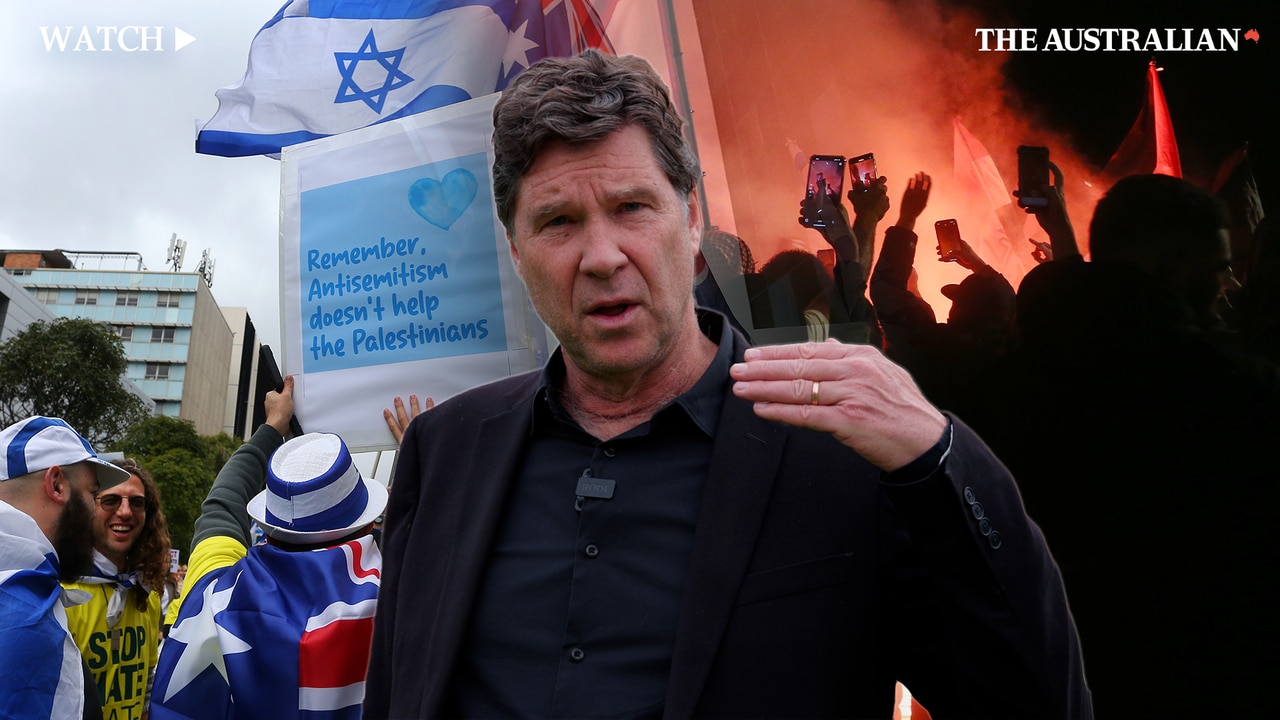
How could I foresee the aftershocks here in Australia – on our streets, in our schools and universities, and even in the corridors of power where “balance” appeased no one and opened a chasm that threatened social cohesion.
I learned the imperative of preserving the centre sitting around the kitchen table, where my father, a self-educated man, spoke of what Maimonides called the “golden mean” – not the coward’s compromise but a discipline for resisting the ever-present temptation towards extremes by holding fast to judgment and proportion.
By centre I do not mean a tepid midpoint between opposing extremes. I mean the place where principle and pragmatism meet, the place where we keep our people safe by adhering to Australia’s core values: freedom, fairness, democracy, equality of opportunity and mutual respect. It takes real discipline to hold that centre when tempers are high and populists, left and right, are tugging at either end. But that is exactly when discipline is needed most.
And despite our country’s often feisty party politics, history shows that Australia is well able to demonstrate such discipline across party lines in its support for Israel, even when the going gets tough. It’s a tradition that stretches back to the founding of Israel.
I think of Evatt again, a Labor icon who, as chairman of the UN Ad Hoc Committee on the Palestine Question, championed the 1947 partition plan that opened the door to Israel’s birth. Evatt saw supporting a Jewish homeland as an Australian moral duty, rooted in our values.
It was Evatt’s government that opened Australia’s doors to thousands of refugees and Holocaust survivors, including my parents, under a bipartisan policy that was expanded under Liberal governments that followed.
We should also be honest about Australia’s failure at Evian in 1938, when our nation refused to increase its immigration quotas to provide a safe haven to Jews, ultimately sent to the gas chambers, on the basis that Australia had “no real racial problem” and was “not desirous of importing one”.

Successive Australian governments have recognised Israel’s right to live in peace within secure borders. Irrespective of the government of the day, here or in Israel, that bipartisan consensus has been anchored in shared values and mutual interests between our two countries, from democracy and the rule of law to trade, education and security co-operation, which remains vitally important to Australia. A shining example that I experienced first-hand was the international campaign to overturn UN General Assembly Resolution 3379, the infamous 1975 resolution that equated Zionism with racism.
In the 1980s, with support from the opposition, prime minister Bob Hawke and his foreign minister, Bill Hayden, navigated tricky internal politics to secure a unanimous resolution of both houses of parliament urging the UN to repeal the offensive resolution. Australia didn’t simply follow “like-minded countries” but led the global campaign to ensure the infamous “Zionism is racism” resolution was consigned to the garbage bin of history in 1991.
The consistent moral clarity demonstrated by Australian leaders towards Israel over so many years has served as a restraint against extremism because it prioritises national values and interests over political expediency.
These values were manifest in the days after the Hamas onslaught, when Anthony Albanese and Peter Dutton spearheaded a bipartisan motion condemning Hamas and supporting Israel’s right to defend itself. We saw it again when the Prime Minister called out hateful protest chants for what they were.
But we also have seen too many instances where clarity has faltered, giving way to what must have felt like political pragmatism but which has fermented something much darker. By attempting to appear balanced in its criticism of Israel, the only democracy in a troubled region, and Hamas, an openly genocidal terror movement, our government has unwittingly opened itself and our nation up to extremes.
That is not to say that the Australian government cannot legitimately criticise decisions of the current Israeli government. Of course it can – as did Hawke, who was widely considered a strong friend and supporter of Israel. The Hawke government had its fair share of disagreements with the Israeli government of the day – yet it also had the moral clarity to lead the world in calling out the inherent anti-Semitism that was responsible for the infamous “Zionism is racism” resolution.

The Albanese government failed to get that balance right. But
Australia has turned its back on decades of bipartisan support for a longstanding ally.
After all, friends disagree; democracies do it all the time. Our community has challenged Israeli governments when necessary – on the Malka Leifer extradition, and more recently by expressing concern about far-right Israeli minister Itamar Ben-Gvir, and the way the judicial overhaul in Israel has been advanced.
The point is to keep criticism values-anchored, without language that erases the distinction between a democratic ally and apologists for terror.
To have recognised Palestine as a sovereign state last month, while Hamas remains in power, holding some 48 Israelis captive in Gaza, was both a slap in the face to bipartisanship and a grave failure of values-based foreign policy.
Predicated on undertakings made by the corrupt and unpopular Palestinian Authority, which has made and broken countless promises for decades, recognition at this time rewards bad behaviour and squanders one of the few levers of influence the international community had left over the Palestinian leadership.
If the Western world had been united and resolute in demanding the prerequisites for peace outlined in President Donald Trump’s peace plan from the day Hamas started this war – dismantling Hamas, the terrorist organisation that controls Gaza, and releasing the Israeli hostages held there for almost two years – the loss of life and terrible suffering experienced by so many could have been avoided, perhaps even those killed and injured in Manchester this week.

The message I want, with all my heart, to convey on this second anniversary of an act of hatred that stirred a primal horror across the Jewish world is that the Australian government must honour the dead, abducted, injured and displaced by restoring our nation’s adherence to principle, by speaking clearly about terror and standing by a fellow democracy, even while disagreeing, however intensely, with some of its government’s policies.
How? By rebuilding bipartisanship towards Israel via a compact of principles, equally owned by the government and the opposition:
• Condemn terror and imported sectarianism.
• Protect lawful protest by people calling for peace and showing empathy towards innocent civilians, but prohibit intimidation such as labelling Zionists as terrorists or calling for a global intifada.
• Call out and condemn those who are far more interested in demonising Israel’s existence and the legitimacy of Australian Jews who support Israel than actually engaging in legitimate critique of the Israeli government.
• Keep foreign policy disagreements values-anchored – criticise policies without obscuring the stark difference between a democratic ally and the purveyors or apologists of terror.
• Do not forget how this war started on October 7, 2023, and the hostages who remain in Gaza.
This is how we restore Australia’s moral centre.
Mark Leibler is senior partner at Arnold Bloch Leibler and national chairman of the Australia/Israel & Jewish Affairs Council.
More Coverage


Is the Liberal Party finished? Don’t bet the rent on it yet

As the second anniversary of the October 7 massacre approaches, I can’t help but reflect on two of the toughest years of my long and fulfilling life as a Jewish Australian.