Bob Davie shows how growing carbon is the new money spinner for Aussie farmers
The money spinner that can be tapped into by any Aussie farmer that’s turning crops, cattle and carbon into cash.

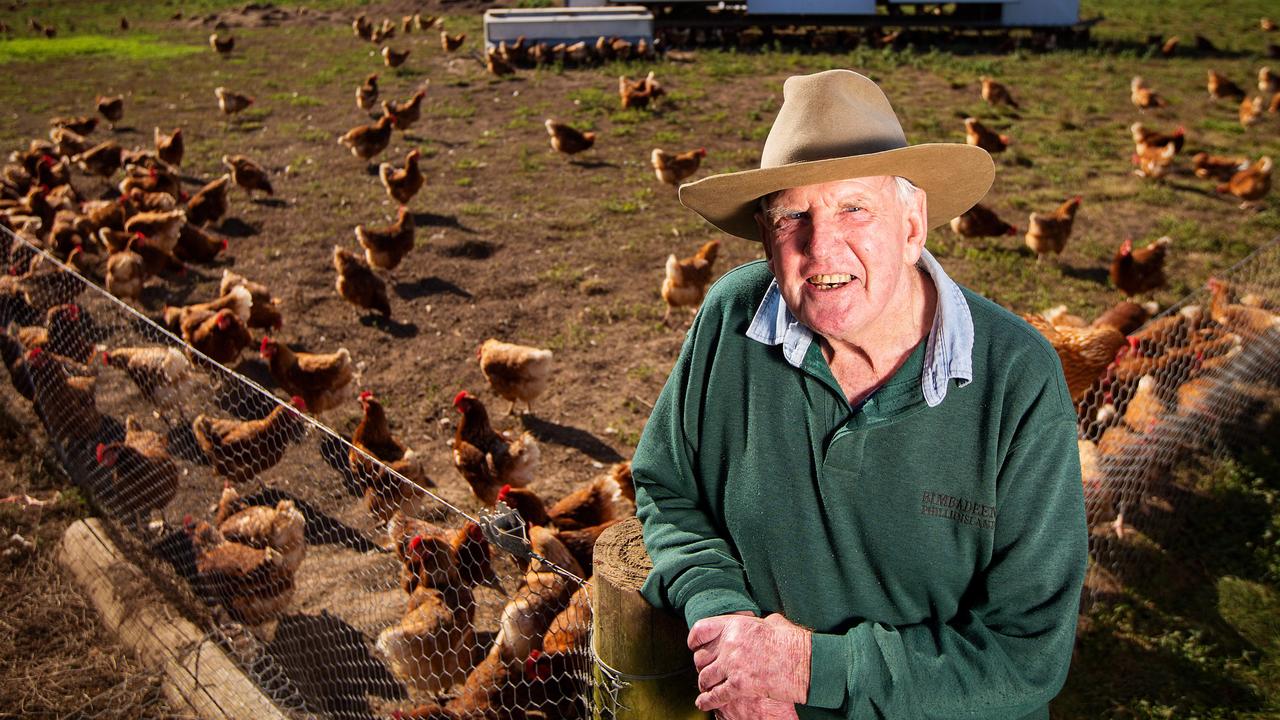
Phillip Island farmer Bob Davie grips a walking stick with a weathered hand and prods the lush carpet of green grass ahead of him for hidden potholes.
Prized cattle chew slowly as they inspect the intruder from a careful distance.
It is an idyllic paddock for grazing, but the contented herd of young Angus are only one part of this picture.
Beneath their hooves is a money-spinner Bob says can be tapped into by any Australia farmer: organic carbon.
“This is M16 – it’s a pilot trial paddock for another 12 months,” Bob says. “In the past 12 months, we’ve put on 10 tonne of total organic carbon on M16, and we hope to increase that by at least the same amount by next year.”
Carbon farming — or carbon soil sequestration — can pull back large amounts of carbon dioxide (CO2) from our atmosphere, Bob says.
Greenhouse gases such as CO2 in the atmosphere act as a heat-trapping blanket, warming the planet. Too much of it leads to temperature rises with disastrous long-term impacts.
As he moves slowly through the paddock, Bob explains “growing” carbon.

Multi-species crops are planted with varying root lengths, ensuring the spread of carbon deeper into the soil, using nutrients available.
Crops are mulched back into the land, while photosynthesis is enhanced by rotating cattle — and therefore manure — through paddocks on a two-day in and out basis.
He points out while cattle produce methane that needs to be offset, it does not stay in the atmosphere for as long as other heat-trapping gases.
Not only that, Bob’s method suggests that soil where cattle have grazed for short periods can produce better results through improved photosynthesis than in non-grazed paddocks or overgrazed pastures.
“The grass strengthens and thickens, providing more density as it grows again,” he says. “The cattle are an important part of it because they put the manure on the paddock and down into the soil. We’ve also introduced dung beetles and this enhances the soil with microbes.”
While Bob is at the vanguard of carbon sequestration, he insists any farmer can get involved — and many would be carbon neutral without realising.
“Carbon just hit me as a no-brainer, and I still can’t understand why farmers aren’t really into it,” he says.
“It’s not hard to do, there is a little bit of expense but you could do it on a small acreage. All the expense only improves your property — a 1 per cent increase in soil carbon can increase your soil moisture retention in a hot, drier climate by up to 150,000 litres a hectare, depending on the soil type.
“A 2ha paddock here would offset all of our greenhouse gas emissions for the whole of the 128ha farm — all the visitor accommodation, all the 2000 laying hens, all the cattle, everything.”
Bimbadeen is named after an Aboriginal word for “place of good view”.
Bob and his father built the farmhouse, overlooking the pristine Phillip Island pastures, in 1955. He knew “nothing” about farming.
He married Anne the following year and they began a dairy operation with a diesel generator and a kerosene fridge.
Almost half a century later, under Landcare’s Greenhouse Gas Emissions Project in 2001, Bob started carbon farming.
In July 2014 the business — which includes tourist accommodation as well as honey, beef and egg production — was declared carbon neutral. “You have to work off a baseline, which is when you do a first carbon test. And then you can trade everything above your baseline after deducting your own property’s greenhouse gas emissions,” Bob says.
“And of course you have to guarantee the amount of carbon is in your soil.”
In other words, you can’t sell credits and then cut down your trees.
Once he obtained his baseline carbon figure, Bob submitted soil tests to government-approved laboratories to check for increases, which could be used to offset other businesses’ emissions.
All the data is maintained by independent auditors and offsets are currently for two years.
At that point Bimbadeen would have been able to earn a steady income from offsets if a market mechanism set up under the Gillard government had survived.
“It should never have been turned to a tax for political purposes,” he says.
“Without that financial incentive many landowners might not see the value in the work they should be doing.”
Currently the federal emissions reduction fund includes carbon soil sequestration for big players, but little for small and medium businesses.
Bob says on the voluntary contract market in Australia he can sell packages for $20-25 a tonne. “In Europe it could be $100,” he says.
Each 2ha paddock on his family’s 128ha farm has an ID number and GPS co-ordinates so people who buy carbon offsets can view their investment on Google Earth.
Businesses that have bought offsets or “insets” — when an organisation invests in sustainable practices in its own industry — have seen value in backing Australian farmers while badging themselves carbon neutral.
“It should be Australian farmers. They are able to do large amount of offsetting to Australian business and isn’t it better to do it from Australian farmers to encourage and assist them in food production them rather than buy credits from perhaps an Adani-owned wind farm in India?”
He lists Dineamic Australia, Luminary Digital and Acacia Environmental as “trailblazer” clients.
Not to mention the Cowes Country Women’s Association.
“They wanted to be the first CWA in Australia to be carbon neutral so we did it, but it was virtually nothing in tonnage. They came up with the idea themselves,” Bob says.
Dineamic general manager Alex Cavuoto says Bimbadeen was supplying beef through Gippsland Natural for Dineamic’s ready-made meals when it put forward a proposal for also supplying carbon insets.
“How they treat the animals, how they treat the land, we know that is sustainable,” Cavuoto says. “Society is definitely moving more towards this, they are actually starting to demand it now. We are taking some of our major buyers like Coles down (to Phillip Island) to see what they’re doing.”
Chief executive and founder of digital agency Luminary, Marty Drill, agrees there is a “growing movement for change”.
Bob is less bullish about the future of carbon farming, without a better mechanism to reward those who create offsets.
But he notes the process has scientific backing of climate gurus such as Professor Ross Garnaut. And it was recently raised by US president Joe Biden’s team as they recast their country’s climate change response.
Those watching on from their farms sat up and took notice.
In 2019, Total Renewable Phillip Island 2030 held a public auction to sell 100 tonnes of total organic carbon.
Auctioneer Greg Price put the hammer down on the first one tonne package from Bimbadeen at an Australian-record $800, and more than $9000 was raised in total.
Bob was surprised by how many smaller packages, worth about $20 and which offset emissions from vehicles, took off “like wildfire”.
All the money from the sales were reinvested, with other Island landowners offered free testing of carbon levels to allow them to start farming.
“If you’re a good farmer and manager you can increase your carbon, then trade in it and get another income, that was not previously there, while improving your farm’,” Bob says.


“Many farmers can’t see the benefits unless there’s a dollar coming into their pockets, and they’ve got to put in a fair bit of work before they get that dollar coming into their pocket because they have to have a baseline.”
Eventually he would like to see farmers across the country responsible for offsetting any business in any town in Australia.
“A business in Ballarat should be getting their offsets off a farmer in Ballarat. An Ipswich business should be getting their offsets off a farmer in Ipswich.”
To enhance mapping and testing on Bimbadeen, Landcare has paid for drone infra-red photography in a bid to correlate moisture levels in soil with carbon content.
The addition of microbes to soil is being tested, too, with the added benefits of increasing quality of the land and productivity and “adding value to your farm”.
Bob says there are now expensive machines being developed for carbon sequestration, but soils and trees were under-utilised. At Bimbadeen, Landcare and groups on Phillip Island have planted 45,000 trees and hope to plant 2000 more every year.
Millions of dollars spent on trials to bury CO2 under the ocean floor off the Gippsland coast could be better spent on trials for farming trials.
“You will see the efficient farmers trying hard will do everything they can to boost the carbon,” he says.
“Why would you not want to receive an income stream from a crop that never leaves your property?
“Why would you bury gas under the ocean, when you can use Australian farmers?”