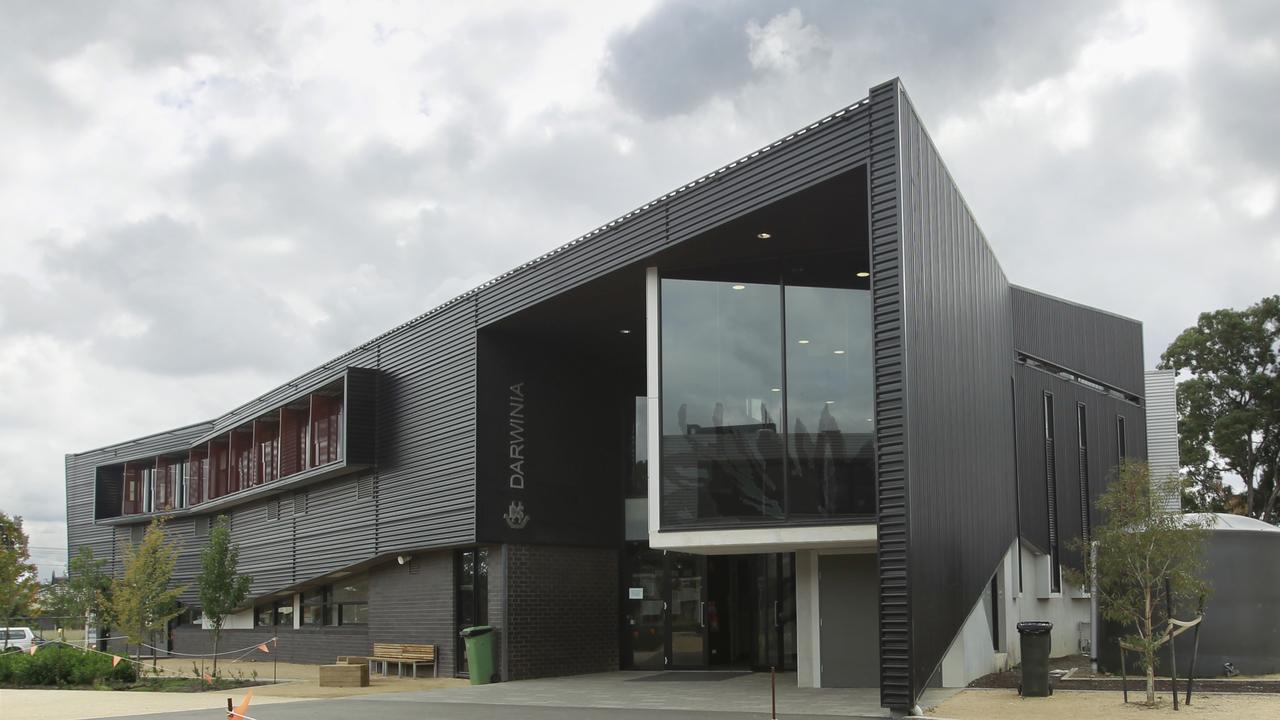
No set year levels, school bells or detention in radical Victorian education shake up
THERE’s no detention, set year levels, school bells or PA systems. And students are telling teachers what they want to learn under a radical program adopted by some Victorian schools — is this the future of the Education State?

STUDENTS are telling teachers what they want to learn, and are even getting alpacas, snakes and drones because they ask for them, under a radical school shake-up.
Under the “Independent Learning Plan”, there are no school bells, no PA systems, and even no set year levels.
At one school, students get in trouble for not having their phones on them: it’s how teachers and principals get in contact.
Students of Year 7 age can take VCE subjects, uniforms may be optional, and pupils can choose what to study, and at what level.
STUDENTS HIRING TEACHERS IN AUSTRALIA
NEW CURRICULUM DEVELOPS KIDS’ LIFE SKILLS
Students run their own coffee carts in the halls, build motorised skateboards in class, create their own clothing labels they wear to school.
And there’s no detention.
The ILP program is at four Victorian schools — Templestowe College, Bundoora Secondary College, Mount Alexander College and Beechworth Secondary College.
There are plans to expand the program to 10 schools next year, and to 20 by 2019.
“If we’re going to claim to be the Education State we need more than numberplates just saying it’s so, we actually need radical reform,” Templestowe College co-principal Peter Hutton said.
Mr Hutton has gone rogue, resigned from the department of education and will take up a full-time job recruiting other schools to the model where “yes” is the default answer to students’ requests.

SCHOOLS STRUGGLING TO COVER THE BASICS
RADICAL PLAN TO STOP DROWNINGS
He called on parents to rally against the “sad” traditional education system that was “failing kids”.
“We need an extreme program because (the system) is extremely broken,” Mr Hutton said.
“Our global education system is based on a lack of trust of students, teachers and principals to make decisions in the best interests of young people.
“How do you justify a system where half of the students end up with terrible outcomes — not just academic but the incredible cost in terms of mental health and loss of feelings of worth as a learner?”
Templestowe student Dylan Reid said mates at other schools were “jealous” he got to build skateboards or guitars in class and create a clothing label where teachers helped with the ABN registration.
“It’s so much better because you’re going to enjoy working, and when you enjoy it, you get so much more out of it,” the 16-year-old said.
As he spoke, one student whizzed by on a motorised skateboard, built in class, past another student — employed by the school — mowing grass in a blue singlet and goggles.
“And you can try a bunch of different things,” he added.

The three Melbourne schools have seen a dramatic enrolment increase in just a few years. Mount Alexander has seen enrolments jump from 280 to more than 400 in two years, and principal Wayne Haworth said: “Families are seeking us out. Students are more engaged and their voices are getting louder — they’re less passive as learners.”
Education Minister James Merlino said “we are very proud of our education system which consistently outperforms other states and territories”.
“The department and parents have previously raised concerns about the teaching methods at (Templestowe College) and in response an investigation was conducted which resulted in an improved focus on literacy and numeracy,” he said.
Department of Education spokesman David Sheridan said Mr Hutton’s claims about the system were “disappointing”.
“Victoria’s education system consistently outperforms other states and territories,” he said.
“The Victorian Government’s record investment in school education and infrastructure is improving student outcomes and making Victoria the Education State.
“Our Education State reforms acknowledge that students have unique perspectives on learning, teaching, and schooling, and should have the opportunity to actively shape their own education.”

Which unis give you best odds of finding a job?