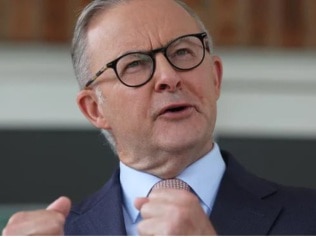
And now we have the bizarre case of Germaine Greer and Bob Carr...
Recently appointed BWF acting chief executive, Ann McLean, has made a number of cringing defences to her decision to drop both writers from the BWF ...
Bob Carr, she wrote “was unsuitable for the topic – What the World Needs Now – and would instead just talk about his new book”.
The unspoken truth of every writers festival is that the topic is always unsuitable for the writer. Topics are understood by all concerned as at best a jumping off point to a general conversation...
And to criticise a writer for talking about their book makes no sense – for what other reason is the writer at a writers’ festival...?
McLean makes an even odder defence of dropping Germaine Greer, arguing that “concerns about the likelihood of media coverage of Germaine possibly overshadowing other writers on the program.” If the BWF is a writers’ festival concerned not to get publicity they are unique on this earth... Is Greer being dropped because her views on rape are not those of the prevailing orthodoxy? Is Carr being dropped because of his views on Israel or population?...
Writers’ festivals now run the risk of running with dogma, with orthodoxy, with the mob – with fear, in other words – and with money. It’s the new Victorian age wearing a hipster beard.
Of course, not all writers’ festivals are like this. But the large ones are increasingly becoming that way. If they were to rename themselves “Festival of Safe Ideas”, or “Celebration of Conventional Thinking”, or “Festival Approved by Twitter Bots” I wouldn’t mind. But having dropped two writers because, it would seem, of what they have written, for Brisbane to call itself a writers’ festival smacks of false advertising.
Who would have thought it would be writers’ festivals that would now act against such freedom?
As I say, Richard Flanagan is someone whose views I often find odd, if not positively alarming. Undoubtedly he would say far worse of me.
But I'd far rather have a festival which would host a conversation between him and me than one which would ban either of us - or Greer, Carr, Shriver and anyone else that may offend the gimlet-eyed and eager-to-be-offended puritans playing their tiresome linguistic power-politics.
I'm talking of the puritans so well described by Simon Copland:
Over the past years there has been growing trend within identity politics in particular, and progressive politics in general, to shut down debate and ideas that do not fit the mantra of the day. What happened in Brisbane was a symptom of this.
Identity politics has become a practice of purity. You have to know the “right” terminology, and be on top of the “right” ideas, or otherwise there is a pile on and you are “cancelled”. I’ve noticed this across a range of platforms, but here are a couple of examples to highlight the point.
A couple of years ago I went to a queer conference in Sydney. A trans woman gave an incredible talk about the interaction between capitalism trans politics. Her analysis was smart and insightful. However, her whole session was dragged down after one attendee complained that she had critiqued a black woman in her talk. Suddenly the room was now debating whether the presenter was a racist, and if it was acceptable to critique people of colour in this forum.
In another example I was once a member of a Facebook group centred around activism to defend the Safe Schools program. At one point a new, energetic member, came into the group, and in a comment was told, politely, that they had used an “incorrect” term in regards to trans people. In response this person announced that they would leave the group because they “didn’t know enough” and were concerned that they would harm people by accidentally saying the wrong thing. This was celebrated by the rest, seen as a model of how people should behave in these spaces.
These are just two examples, but I could go on and on, as could almost everyone I know who has ever engaged in this politics. Watching this unfold I ask myself, how is this a space, or a politics, that fosters learning, development, new ideas, or even solidarity?
Even some of the core ideas of identity politics highlight a tendency to shut things down.
Safe spaces, once designed to literally keep people safe from violence, are now really more a place to hide from ideas that make people uncomfortable. Concerns over racist language are seeing classic novels removed from school syllabuses in the United States, while there has been discussion about removing texts from courses in universities in order to protect students...
Even the idea, prominent within identity spaces, that people should only speak within their experience, or should “stay in their lane”, shuts down our capacity to engage in broader structural critiques that connect issues together. It removes any potential for us to build bonds of solidarity, empathy and community.
Within identity politics issues are frequently seen as being very black and white. You are either a bigot or not, and if you are you need to be kicked out. Concurrently, as discourse about the nature of oppression of minority groups has become broader, so have the definitions of what it is to be a racist, homophobe, sexist etc. To engage in this politics one is expected to keep up — to be continuously “educating ourselves”.
What Copland is describing is the rule-setting by those of tiny minds, erecting a labyrinth of merely ritual conventions to preserve their power, not advance their understanding. These are Pharisees insisting on their endless thou-shalt-nots against a preacher revealing a revolutionary truth. It's the club against the idea. Rules above results.
Question: why do taxpayers then fund writers festivals that do this?