‘Magnificent’ crops no more: Farms go under as Murray River rises at Echuca-Moama
Crops in Echuca and Moama on the Murray River are the latest casualties in a week of destruction as flood waters move downstream.

At Fleur Ferris’ property near the Murray River in Moama, the farmer and author spent Thursday watching flood waters inch toward what were once ‘magnificent’ crops.
Ms Ferris has 120ha of wheat planted across two properties at Moama. Until Thursday the plants were standing tall and healthy, heavy with grain filled from months of bountiful rain and irrigation.
By Thursday morning the “stagnant puddle” of floodwater that had formed as the flooded Goulburn and Campaspe rivers emptied into the Murray had moved to within 500m of Ms Ferris’ main property.
By Thursday afternoon, it was on the move again, the brown water flowing quickly toward the crops.
“If the water comes up to where we’re expecting, we will lose those crops here (on the home farm in Moama).”
“We’re also leasing land nearby (in Moama). Those crops I believe are already underwater. We can’t get there now,” Ms Ferris said.
“It’s just heartbreaking. We’ve had such a good year and we got such heavy spring rain that was filling (the irrigation bays) and to think there’s now the possibility of losing them at the end.

“But that’s farming. There’s always that risk.”
North-west of the family property, at Bunnaloo in NSW, Ms Ferris had another 400ha of irrigated and dryland wheat and canola.
Water was already spilling over from irrigation channels into the irrigated crops, and could reach the dryland areas if heavy rain forecast for this week eventuated.
The Bureau of Meteorology has forecast rainfall of 30mm to 60mm for northern Victoria and Southern NSW on Friday and Saturday.
Luckily, the family also has a block of land at Chinkapook in the Victorian Mallee, which was unlikely to be affected by October’s wild weather.
“We were cursing (the Chinkapook block) at one point because it was so far away. But now we’re really happy that we made the effort and did it,” Ms Ferris said.

Community spirit strong
The community of Echuca-Moama has banded together to help each other as flood waters approached the town.
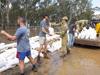
On Thursday “40 to 50” people descended on the Ferris home and had covered doors and windows with sandbags and sheets of plastic to protect the house from floodwater.
“The community has been amazing.
“Some of (the people who came to help) were neighbours of friends who didn’t even know me. Half of them were teenagers. The youngest was 11, lifting heavy sandbags.

“They just came in, did the job and then moved on to the next house.
“It’s quite overwhelming when that sort of thing happens, when so many come to help you.”
On Wednesday night the NSW State Emergency Services responded to 174 requests for assistance across the state, while the Rural Fire Service worked to distribute sandbags.
Victoria’s State Emergency Services responded to 191 calls for help in the 24 hours to 2pm Thursday, including nine rescues.
The #NSWRFS has several helicopters currently deployed throughout the state assisting the @NSWSES with reconnaissance and transporting sandbags and supplies. Yesterday, crews used one of the helicopters to rapidly deploy sandbags after a breach was detected in one of the levees. pic.twitter.com/9m6XvKfrrL
— NSW RFS (@NSWRFS) October 19, 2022
Hopes for east coast crops downgraded
Crop production estimates for the 2022 season have been heavily downgraded on the east coast, according to a new assessment released this week.
Rabobank’s latest winter crop report, published on Monday, was one of the first to assess the true scale of the damage inflicted by October’s wild weather.
The report found areas in NSW were facing a trifecta of yield, volume and quality downgrades as a result of heavy rain, washed out fields and “unharvestable” crops.
RaboResearch agricultural analyst Dennis Voznesenski said the total harvestable area was expected to shrink by up to five per cent compared to previous estimates.
“Before these most recent rains, we were expecting around 85 per cent of the area planted for grains and oilseeds to actually be harvested. And with these rains, I wouldn’t be surprised if that goes further towards 80 per cent,” he said.
Total production in the state was expected to be 12.8 million tonnes — down 28 per cent compared to the 2021-22 harvest.

Queensland production was also forecast to fall by six per cent, with crops affected by waterlogging in the south of the state.
Mr Voznesenski said crops in Victoria’s flood-affected areas along the Goulburn, Campaspe, Loddon and Murray Rivers would be the worst affected by October’s heavy rain.
It was possible as much of 20 per cent of the area planted to crops in Victoria may not be harvested this year, but it was “too early to tell” what the full impact of the waterlogging would be, he said.
Victorian grain grower and Grain Producers Australia southern director Andrew Weidemann said this year’s crop was on a knife’s edge.
“It has continued to rain well past the point where it was needed in many grain producing regions and growers are now set to realise those losses, with downgraded crop quality and crops that are un-harvestable,” he said.
Mr Voznesenski said what was a “heartbreak” for some farmers was not bad news from the industry as a whole.
Australia was on track to harvest a near-record winter grain crop of 61.9 million tonnes, a 41 per cent increase on the five year average.
More than one third of that production was expected to take place in Western Australia, where the crop was forecast to be one per cent larger than 2021-22’s harvest of 21.3 million tonnes, which set a new record in the state at the time.
South Australia was also forecast to harvest a bumper crop — 27 per cent larger than 2021-22’s harvest total of eight million tonnes.


‘A long summer ahead’: Fires destroy farms, homes