
Diary’s revelations lead to a welcome homecoming for Pilbara artefacts
A Swiss horticulturalist’s diary has enabled the return of Indigenous objects taken from Western Australia more than a century ago.


Harry Mills holds the shield and spear made by his ancestors, and the lessons from his youth rush over him.
In his Yindjibarndi language, 78-year-old Mills begins to sing the songs the old people taught him on traditional lands 1500km north of Perth.
An epic effort has confirmed the shield and spear and six other precious Yindjibarndi objects left the Pilbara in 1913 with Swiss horticulturalist Fred Schelling. After Schelling’s death in Berkshire, England, in 1963, his daughter Joy displayed the objects proudly in her home in Hampshire.


Joy died last year aged 93, leaving her daughter Christine Tremain to unearth clues that ultimately sent the objects on a 14,000km journey home.
Their arrival last week in the Pilbara town of Roebourne was a happy event. Senior Aboriginal people recognised the shield’s distinctive lines defining 13 family groups of the Yindjibarndi nation. As local leader Michael Woodley used a drill to unseal the metal trunk containing two boomerangs, four wooden spear heads, the spear and shield, Aboriginal children stood on their toes for a better view. Elders cheered.
“We know they took good care of these things,” Mr Woodley said. “Having them back on Yindjibarndi country is very important to us.”
It is the first repatriation from a private collector under the Australian Institute of Aboriginal and Torres Strait Islander Studies’ initiative called Return of Cultural Heritage, which has successfully encouraged institutions around the world to return significant objects.

It was Schelling’s diary that left Mrs Tremain and her husband Ian in little doubt about where the objects came from. Translated from Old German to German then from German to English, Schelling’s journal reveals wide-eyed wonder at life in the Australian outback in 1910. He was 22.
Schelling, from the wine-growing town of Schaffhausen on the Rhine River, had been growing fruits and vegetables in greenhouses in England when he applied for and was offered a job at the now defunct Millstream Station in the Pilbara. He landed at Point Samson on a wool ship.
He was surrounded by unfamiliar plants and animals. On his first night at Millstream - December 31, 1910 - Schelling woke in his garden hut to the sounds of what he thought were heavy winged birds flapping boisterously.
“To my utter astonishment they squealed like young pigs every now and then. With the thought of them most probably not wanting to eat me, I went back to bed. I barely had lay down, when I heard a noise coming from inside my hut,” he wrote.
“I did not have a lamp yet, therefore I only lit up a little match. To my horror I saw a snake slithering along the floor of my hut.
“Before I could inspect it further or even kill it, the little match burned into my fingertips. I lit many more matches, but could only find the track that was going back into the bananas. Again I didn’t have another choice but to think ‘it most probably will not eat me’.
“My tiredness overpowered me and soon I was asleep. In the morning I woke up at sunrise and was unharmed. “At breakfast I told everyone of my nightly visitors. The blacksmith said that he would not sleep for anything in the garden, as there would be oodles of snakes.
“The cook however calmed me and told me that the Chinese gardener always slept in the garden and that the snakes only catch mice in the hut. The ‘manager’ told me that those weird birds are actually flying foxes (mammals) who would feed on the unripe dates every year.”
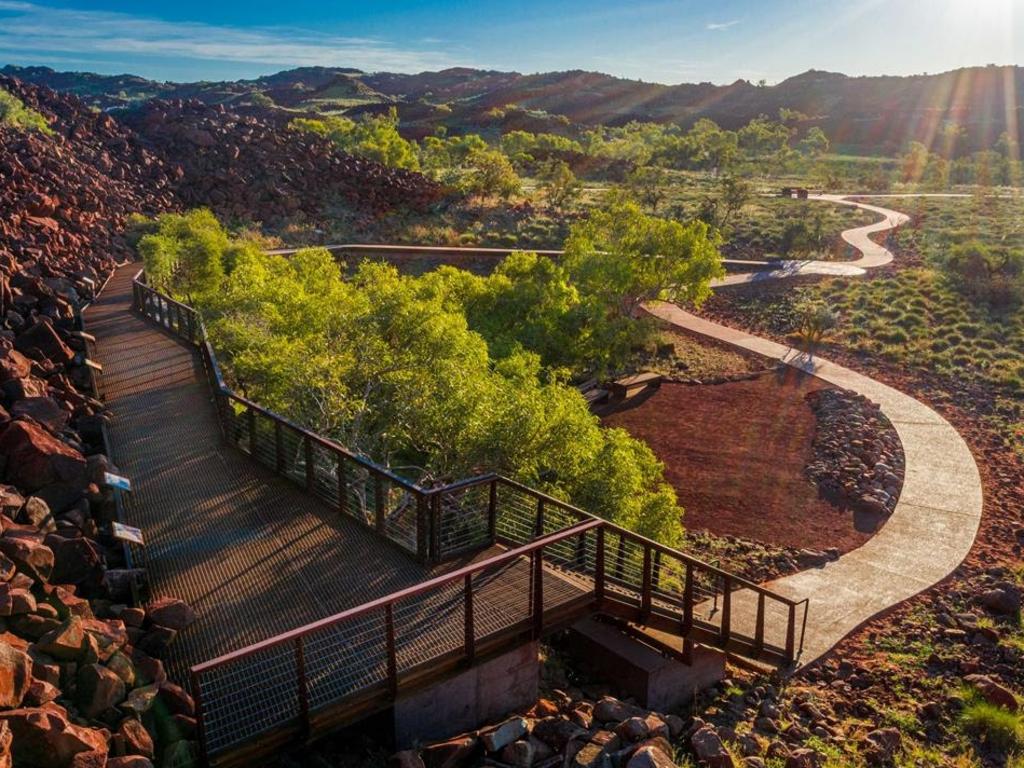
Schelling sketched what he saw in his journal and wrote detailed descriptions of the geography of the station, now part of a national park. He noted the high iron content of the soil. He took delight in a waterhole - which he called a pond - and bathed in it every second day.
“Around the pond are some types of Eucalyptus trees. The mighty branches are hanging far into and across the water,” he wrote.
“The lush water plants and slim water grasses are alive with colourful birds and dragonflies. This gives the pond a picturesque sight, and the whole magnificence is reflected in the clear depth of the water.
“The wonderful coloration’s in this tropical water are hard to describe, they are that enchanting and fairy-tale like, that I once nearly forgot to surface again.”
Schelling noted the Yinjibarndi lived and worked on the property and worked with five white stationhands looking after the sheep and cattle. He described in detail the plants and trees he saw and how the Yinjibarndi used them for shelter and to communicate.
He made a note that spinifex was “a strange type of grass. The same grass forms a bush, which looks like an almighty green porcupine and is not differing much from one when you consider its prickliness. Everyone should actually try for themselves to walk through this type of grass and will how hard it is”.
“You can hardly find something more suited for fire material, as the grass has got a big resin content,” he wrote.
“The Indigenous gather the resin and use it partly to make their wooden weapons.”
Schelling wrote of tall trees covered with a cloth-like white bark.
“Once you set the bark alight it burns to the highest point of the tree without ruining it and creates a thick smoke. The indigenous use this occurrence to send signals,” he wrote.
“The bark can easily be separated into many big layers and because of it being waterproof, the black indigenous are using them to build huts and camps etc.”
The journal did not include any references to the Yinjibarndi gifting or selling the eight objects to Schelling but his clear interest in their practices made Mrs Tremain comfortable that Schelling got the objects during his three years in the Pilbara. It was reassuring to hear Woodley, the Yinjibarndi leader who opened the trunk this week, as he described the zig zag lines on the shield as unmistakably from the region.
Schelling’s writing was a revelation for Mrs Tremain, who was 13 when Schelling died. She remembers him as quiet, gentle and especially resourceful. He never told her about his time in Australia.

In the months after Mrs Tremain’s mother died and the family sorted through her things, Mrs Tremain said other members of her family agreed with her that it would be wrong to take the objects to a dealer or an auction house. She said it felt even better than anticipated to send the objects back to the Pilbara where they were made. “It was the right thing to do,” Mrs Tremain said.
“I could see how much it meant to them. That was nice.”



To join the conversation, please log in. Don't have an account? Register
Join the conversation, you are commenting as Logout