
First-home buyer scheme to fuel property price surge, warn experts
Property experts warn the Albanese government's expanded low-deposit scheme is driving up home prices, with mortgage applications surging 39 per cent in October.


Today’s first-home buyers will price out the hopeful homeowners of the future, warn property experts who are expecting the Albanese government’s expanded low-deposit purchase scheme to push up the cost of housing.
October marked the first month of the Albanese government’s expanded Home Guarantee Scheme, which allows first-time buyers to enter the market with a deposit of just 5 per cent.
The changes removed the limit on the number of households allowed to access the scheme, as well as income caps, while raising the maximum property price in most capital cities and regions.
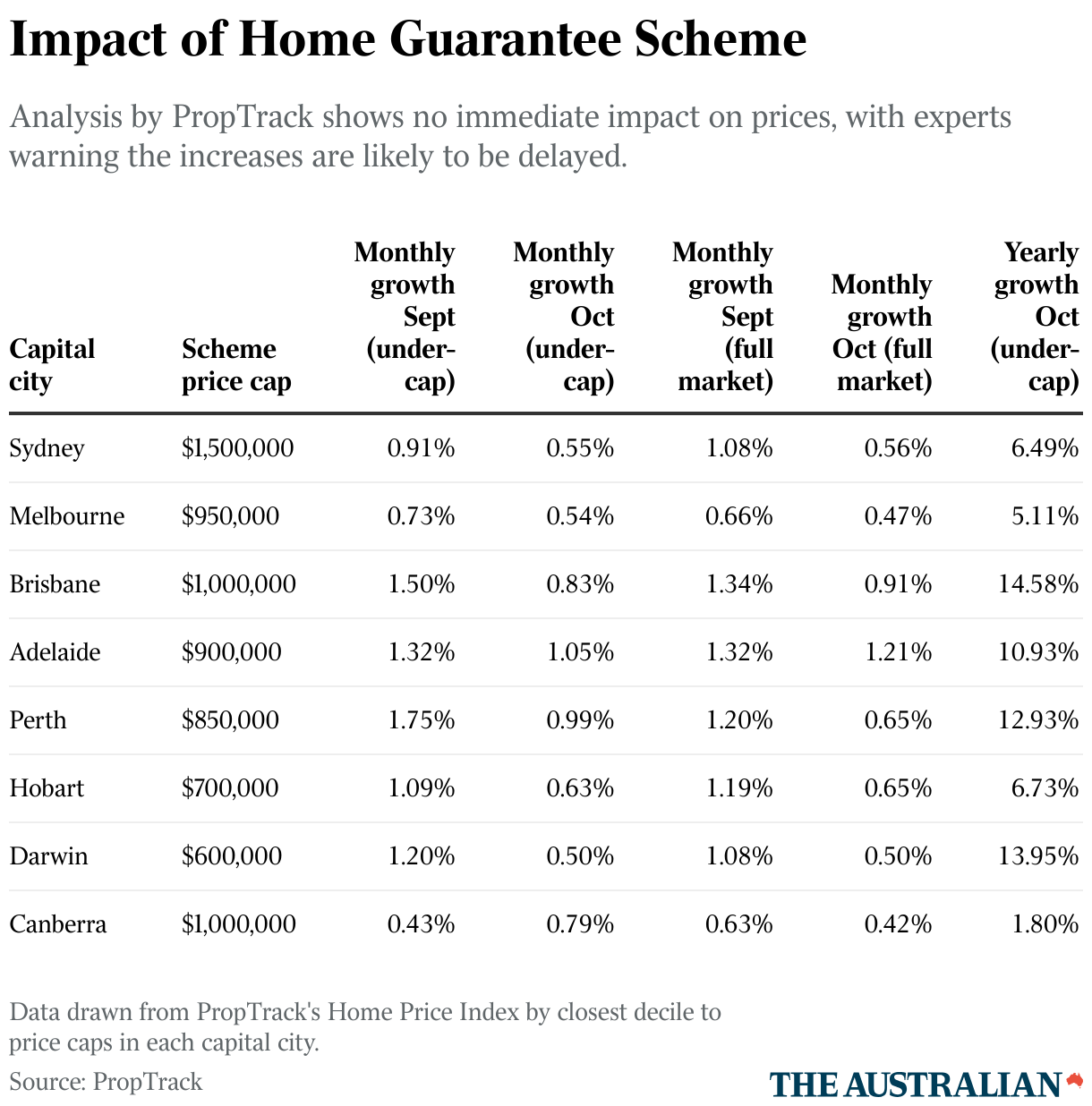
Prices at the more affordable end of the property market under the new price limits of the scheme have been rising faster over the past year, according to analysis by housing researcher PropTrack for The Australian.
While there were no significant changes in the month-on-month figures – despite the federal government claiming one in 10 home sales took advantage of the scheme in October – a surge in first-home buyer interest in lending is expected to signify additional pressure in the coming months.
One of Australia’s largest mortgage broking firms, Loan Market, revealed a 39.2 per cent increase in the weekly number of mortgage applications through October when compared to the September quarter.
The biggest jumps were in Queensland (up 55.2 per cent), South Australia (up 44.9 per cent) and Western Australia (up 38.9 per cent), where capital city prices have almost doubled over the past five years. NSW was up 34 per cent, while Victoria rose 33.5 per cent. Loan Market chief executive Sam White said it would take several weeks for these applications to turn into settlements due to the continued lack of homes for sale.
“One of the challenges is buyers finding property to actually buy,” Mr White said. “A lot of the numbers of the volume of transactions probably won’t kick in more until the new year.”
REA Group executive manager of economics Angus Moore agreed it could take time for the full impact of the expansion to be felt. “The initial signs are that the schemes are pretty popular,” he said. “I’d expect it to take anywhere from sort of three to six months before we start really seeing that activity showing up.”


Price caps in several locations have almost doubled since the Home Guarantee Scheme was first introduced by the Morrison Coalition government in January 2020 as a way to help 10,000 households each year into “modest” homes.
In Sydney, the new price cap allows market entrants to take on 95 per cent of the debt for a $1.5m home, with maximum prices also up to $1m in Brisbane and Canberra, $950,000 in Melbourne, $900,000 in Adelaide, $850,000 in Perth and $700,000 in Hobart. Despite Darwin recording the largest increase in property prices this year, the cap remained unchanged at $600,000.
Tim Lawless, head of research at housing researcher Cotality, said the scheme would help buyers today but not tomorrow.
“This is first-home buyer stimulus for today’s first-home buyers that doesn’t do much for tomorrow’s first-home buyers,” he said.
“If you’re a mainstream buyer earning the median household income you probably can’t afford to buy the median price dwelling anymore. So, the first-home buyer deposit guarantee has probably amplified demand to some extent in those lower price points.”

First-home buyers represent 23.4 per cent of all buyers, and are taking on 19 per cent of the new lending pool. Both figures are a couple of percentage points below long-term averages, a sign of affordability pressure. They are in competition with investors, who account for more than a third (37.7 per cent) of new mortgages.
Mr Lawless said it was difficult to determine how much of any potential price increase in this segment of the market could be attributable to the scheme.
“Investors are heavily motivated by opportunities for capital gain … given the fact that there’s broadbased speculation that this program will provide some additional upwards pressure on prices and very specific segments of the market then, it wouldn’t be surprising if investors would be getting in on it,” he said.
More Coverage


To join the conversation, please log in. Don't have an account? Register
Join the conversation, you are commenting as Logout