
AI literacy or a trade ‘the best path for school leavers’
Trades and nursing emerge as the safest career choices as artificial intelligence threatens to eliminate traditional office and marketing roles across Australia.


School leavers would be wise to take on a trade or learn to use artificial intelligence, as the technology takes a knife to entry-level jobs, Jobs and Skills Commissioner Barney Glover has advised.
Jobs and Skills Australia will release a landmark labour-market study on Thursday that reveals workers in sales, marketing and public relations, as well as programmers, office clerks, receptionists and business analysts, are most at risk of losing their jobs to an AI chatbot.
The safest occupations are nurses and midwives, construction and mining labourers, business administration managers, hospitality workers, and cleaners.
Professor Glover called for better vocational education and training in schools.
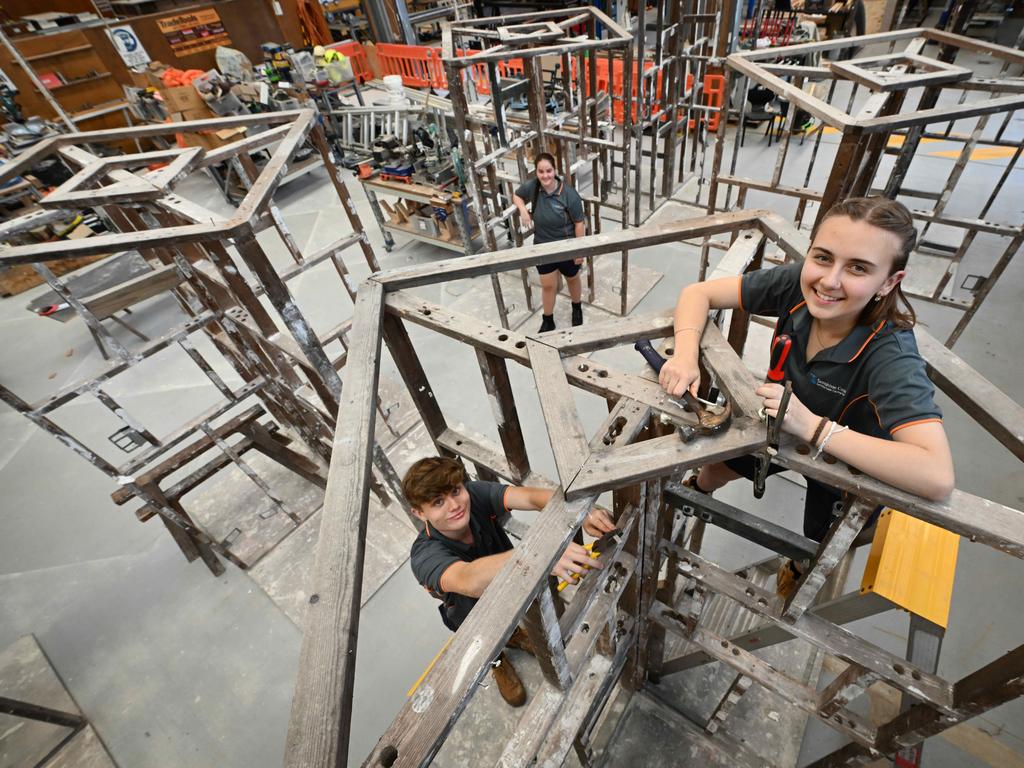
“Trades are very secure for the future,’’ he told The Australian.
“In increasing numbers we’ve got to be able to provide (school students) with pathways into VET qualifications, including all the trades.
“It’s a very secure set of occupations so I’d encourage young people to think about (a trade), alongside going to uni to do a degree – but make sure you get AI competent and AI fluent because that’s going to help in whatever career you choose.’’

Professor Glover also called on universities and VET providers to “get on with’’ introducing more short courses in digital technologies and AI to help existing workers upskill.
He said industry must be involved in changing the tertiary education curriculum to “future proof’’ graduates.
Too many workers were qualified but still “not getting jobs’’, Professor Glover said.
“Industry tells us they haven’t got the right employability skills, the right cognitive skills, they don’t have enough work-integrated learning or work placement experience,’’ he said.
“We need to see some changes in the education and training system to respond to AI – let’s get on with it.’’
Professor Glover said Australian students and workers would need better foundational literacy, numeracy and digital skills to harness and master the fast-evolving AI technologies.
JSA’s Generative AI Capacity Study warns women and disabled people are at higher risk of AI taking their jobs, which are concentrated in administrative and clerical roles that can more easily be outsourced to a bot.
The research also warns many workers are secretly using AI without their employers’ knowledge or permission, “indicating grassroots enthusiasm but also raising governance and risk concerns’’.
“Gen AI is accelerating skill change,’’ the report states. “The technology is increasing demand for both digital literacy and higher-order human skills like critical thinking communication and adaptability.
“Lifelong learning is essential … continuous upskilling and reskilling (will) become critical for maintaining employability and productivity.’’
The JSA study says AI may automate routine tasks often performed by junior staff, but so far “there is no current evidence of widespread displacement’’.
“This may partly reflect the early stage of adoption in Australia,’’ it states. “Entry-level roles are also likely to evolve, requiring more judgment and oversight of AI-generated outputs.
“Women, older workers, First Nations Australians and people with disability may face disproportionate risks due to occupational concentration and digital access gaps.’’

The report says one in five occupations has a medium to high likelihood of automation by AI. But it predicts that AI is likely to augment, rather than annihilate, highly skilled professions such as law and medicine.
“Many clerical tasks – which were not affected by previous waves of automation – could now be undertaken in large part by Gen AI,’’ it states.
“Highly skilled occupations could discover new efficiencies.’’
JSA found that many workers have already sourced their own AI tools and training, to save time or be rewarded for improved work quality and performance.
“Many employees have reported using Gen AI without the knowledge of their managers,’’ it states.
“(This) ‘shadow use’ results in responsibility for governance and risk management being transferred to the worker.’’
AI may save time for some workers – but for others it will bring heavier workloads, the report finds.
“Gen AI tools can improve productivity, particularly in routine, text-heavy tasks and among less-experienced workers,’’ it states.
“If automation occurs for repetitive, low-intensity tasks, this could … free up time for more important and specialised uses.
“The Gen AI transition could also see more highly skilled people being overemployed – people with too much work, including people working longer hours.’’
JSA warns that AI could threaten workers’ wellbeing by making work more intense and stressful.
“Where highly skilled workers are increasingly tasked with validating Gen AI outputs and processes, this could increase cognitive load and accountability for the worker,’’ it states.
“Some workers could experience an intensification of their workday – a situation where a person’s workload is increasingly comprised of challenging tasks without the reprieve of low-intensity tasks or adequate breaks.
“At the extreme, intensification poses risks to worker wellbeing.’’
The report also warns against a reliance on AI to assess job applications, given the risk of discriminatory AI algorithms.


To join the conversation, please log in. Don't have an account? Register
Join the conversation, you are commenting as Logout