
Debt and deficits pile up ahead of transition to net zero
As Canberra splurges well beyond its means, rising debt – set to reach $1 trillion in coming months – is making voters anxious.


Australians are living through an age of anxiety. The post-Covid years have been a grind of savage consumer price rises and stagnant living standards, overlaid with rolling crises, market volatility, financial and security threats from afar and brutish populists on the march.
A pervasive uncertainty has taken hold among shoppers and investors; the nation can’t seem to get out of first gear. The latest wave of the platinum-standard Household, Income and Labour Dynamics in Australia survey, which began tracking families in 2001, reveals a growing sense of dread, mental distress and financial strain. Voters are trying to move on from the pandemic’s cold grip, but progress is fitful.
While Anthony Albanese held to the middle ground on May 3 on a no-surprises platform of more of the same social spending and higher borrowing, the time is ripe for a new conversation about deficits and debt, which the research suggests voters are hungry to engage in.
Certainly, the participants at last month’s economic reform roundtable Inquirer exit-polled have emerged with a clear sense that the budget needs to be more sustainable. It’s slowly seeping into community feeling that, with more debt, unaffordable housing, fewer babies and technology gobbling up work, maybe the kids won’t be all right.
In its incoming brief to Jim Chalmers, Treasury said taxes would need to rise and spending cut if the federal budget was to be sustainable. We also know the transition to net zero, without an economy-wide carbon price, will be more costly and disjointed.

The independent Parliamentary Budget Office delivered its annual fiscal health check on Thursday. The budget will be in deficit for a decade, due to rising costs for social services, defence and debt interest. And that’s assuming there’s no more tax relief, as bracket creep claws back a greater share of income, especially from young workers in an intergenerational grift Labor has said must be addressed.
It’s also unlikely we can achieve the productivity growth of 1.2 per cent a year the budget papers assume. We’re in a long-running form slump. As Productivity Commission deputy chairman Alex Robson says, “Australia’s workforce is barely more productive now than it was prior to the Covid-19 pandemic.”
As well, the PBO urges the government to avoid hazardous money pits by not designing future programs along the lines of the National Disability Insurance Scheme. While growth in the NDIS, budgeted at $52bn this financial year, appears to have eased slightly, the PBO says “further moderation will be required to make this program sustainable”.
This week Sussan Ley put down several rhetorical markers about public finance, most ardently about moving from “a time of dependency to empowerment”. By dependency, the Opposition Leader meant the “growing expectation that government will provide for every need and solve every problem by spending more”.
“My message is that we must put guard rails around government spending, not as an end in itself but so that we can strengthen our economy, preserve our capacity to help those truly in need and ensure the next generation inherits opportunity, not debt,” Ley told the Committee for Economic Development of Australia on Wednesday.
In her fiscal critique, Ley said Labor was “essentially running a peacetime economy on emergency fiscal settings … Yet the current government appears in no hurry to adjust. In fact, they proudly tout any new spending as evidence of their generosity. The problem is they are being generous with borrowed money.”
Ley’s contribution was instantly derided by the Treasurer. Chalmers claimed it was an appeal to “cookers and crackpots”. It was obviously much better than that and would have been welcomed by the Coalition base had it been part of Peter Dutton’s pitch to voters.
Instead, they were presented with an offering large on cost, wobbly on belief, with a fiscal nod and a wink, as we merrily go accounting. The electorate, impolitely, implausibly, spurned this non-traditional Liberal-Nationals three-legged scramble to polling day.

Ley at least set down solid principles like “government should live within its means”, “quantifiable fiscal rules” and ending upper-class welfare, to remind her flock about values that went down the S-bend under Dutton and Angus Taylor.
Those guys talked tough about “big government” but went to water on policies that would curtail its growth. In fact, on things such as business lunches, mortgage deductibility and nuclear energy, they were prepared to stiff taxpayers.
In her CEDA speech Ley said getting the budget in better shape “will require leadership and honesty. There will be tough calls ahead.”
Canberra’s budget-watching class marked it as a decent opening burst, coherent and on-brand aspirational. But that’s it. A low-fi start. Conservative politics is a bin fire of ego, bastardry, contumely, and free-play. As we all know, from say 2010 to 2018, give or take, these internecine blood rituals are not the main game for Australians.
Voters want economic reform and action on the budget. According to unpublished public opinion research this month shared with Inquirer from JWS Research for its True Issues survey, ordinary Australians are concerned by the deterioration in the budget and where the level of national debt is heading.
A majority (58 per cent) of the 1000 voters polled in a national sample are inclined to back budget savings measures to address it. Among those who have “definitely heard” about our deficit and debt level, support for action is at 72 per cent.
JWS Research business development manager Tom Cameron says the more the state of the budget becomes an increasingly prominent aspect of the national policy and political debate, “a reliable consequence is likely to be a higher proportion of the electorate willing to entertain the need for budget savings to deal with the problem”.
Majority support for spending cuts is still present for lower-income households, non-university educated, renters and unemployed. The JWS Research suggests those at the more vulnerable end of the economy are receptive to the argument for tightening the budget belt. Opposition to the idea of budget savings is at a very low 8 per cent among ALP voters and 14 per cent for Greens supporters.
Cameron says the research helps to “highlight how the virtue of thrift is still alive and well in the general population even if it hasn’t been much of a feature of the political contest in recent times”. “The task then of course – especially for the government – is navigating where specifically to tighten the belt and how to most effectively make the case for those hard calls,” he says.
The PBO’s Beyond the Budget report highlights the federal deficit’s trajectory across the coming 10 years and the broader question of fiscal sustainability for the 40 years at the end of the current four-year forward-estimates period.
“While the economic assumptions effectively allow for a business cycle, if future economic shocks are greater than those of the past, the budget will need to build larger buffers during periods of growth,” the PBO states. “Like most budgets over the past 20 years, there are no tax cuts assumed beyond those already announced.”
That’s bad news for younger workers, who are carrying the burden for an explosion in aged care and pension costs, which are set to be even higher than spending on defence, debt interest and the rampant NDIS. As we boomers fade into our golden years and can’t maintain the rage against paying more tax in our dotage, who among us will defend the sanctity of earnings on our nest eggs?
“The increasing reliance on personal income tax to balance the budget limits the government’s ability to provide relief from bracket creep, resulting in higher average tax rates for wage earners, spreading the tax burden unevenly between generations,” the PBO says.
“Older Australians, who are more likely to derive income from savings, investments and superannuation, benefit disproportionately from lower taxes, while younger and working-age individuals bear a heavier tax burden on their labour.”
As well, governments always assume grant programs will end but then always find new ways to spend. The PBO says the decade of deficits projected could turn out to be far worse because spending might be understated by as much as $50bn in 2028-29.
“If this is the case, budget deficits and higher levels of government debt will continue through the medium term and beyond, with large policy adjustments required to restore fiscal sustainability,” it says.
Commonwealth Bank chief economist Luke Yeaman sees the NDIS and defence as the two “elephants in the room” for budget sustainability. While not yet in danger, the nation’s AAA credit rating will come under scrutiny in coming years given the structural pressures on spending and taxing.
“Australia faces a difficult choice moving forward,” the former Treasury deputy secretary wrote in a note this week. “The public has accepted (and in some cases demanded) a higher level of spending and service provision. And there is a general view that defence spending will need to lift to properly defend Australia in a more dangerous world.
“The question is, will that same public accept net tax increases in the order of 1-2 per cent of GDP to properly fund those services and balance the budget. If not, then we will likely see debt steadily increase over time, as it has in many other advanced economies.”
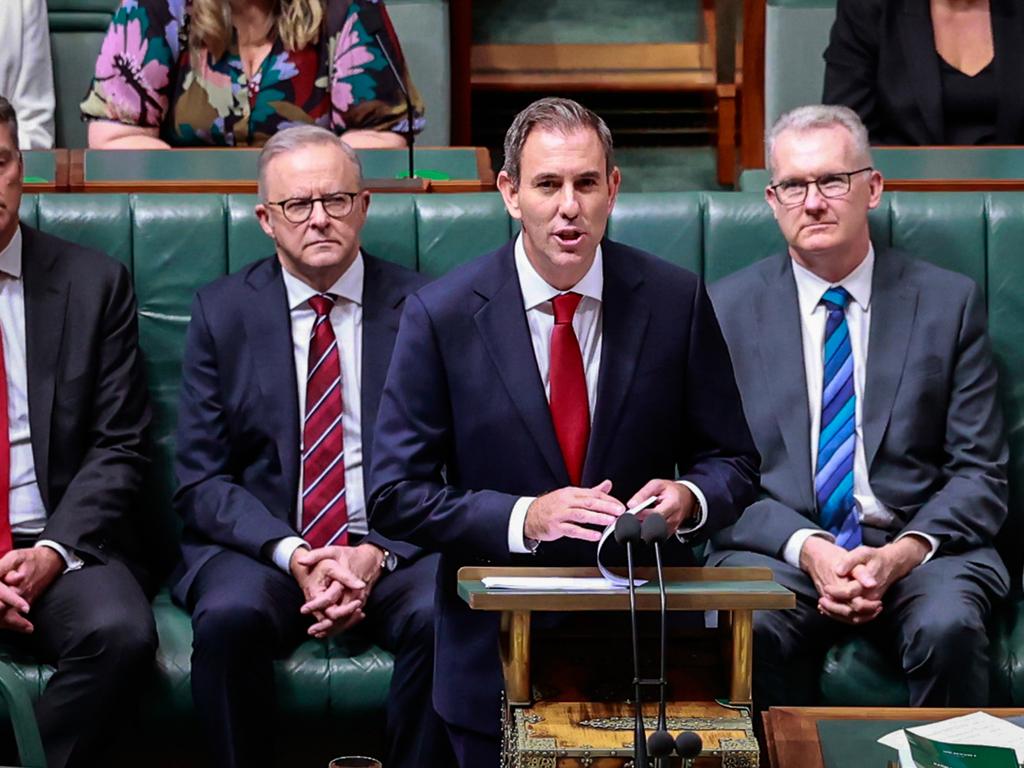
When gross debt reaches $1 trillion in coming months Labor’s tedious narrative of “Liberal debt” will have to die. Elected in 2022, the Albanese government has super-sized its majority to an immense girth while indulging its innate spending tendencies.
Labor owns the parliament, as well as all the political perils of a federal budget preset for deficits.
More Coverage



To join the conversation, please log in. Don't have an account? Register
Join the conversation, you are commenting as Logout