ANU academic blames chancellor Julie Bishop for ‘near suicide’
ANU chancellor Julie Bishop faces serious allegations of workplace bullying after an academic's devastating testimony about near-suicide and miscarriage.

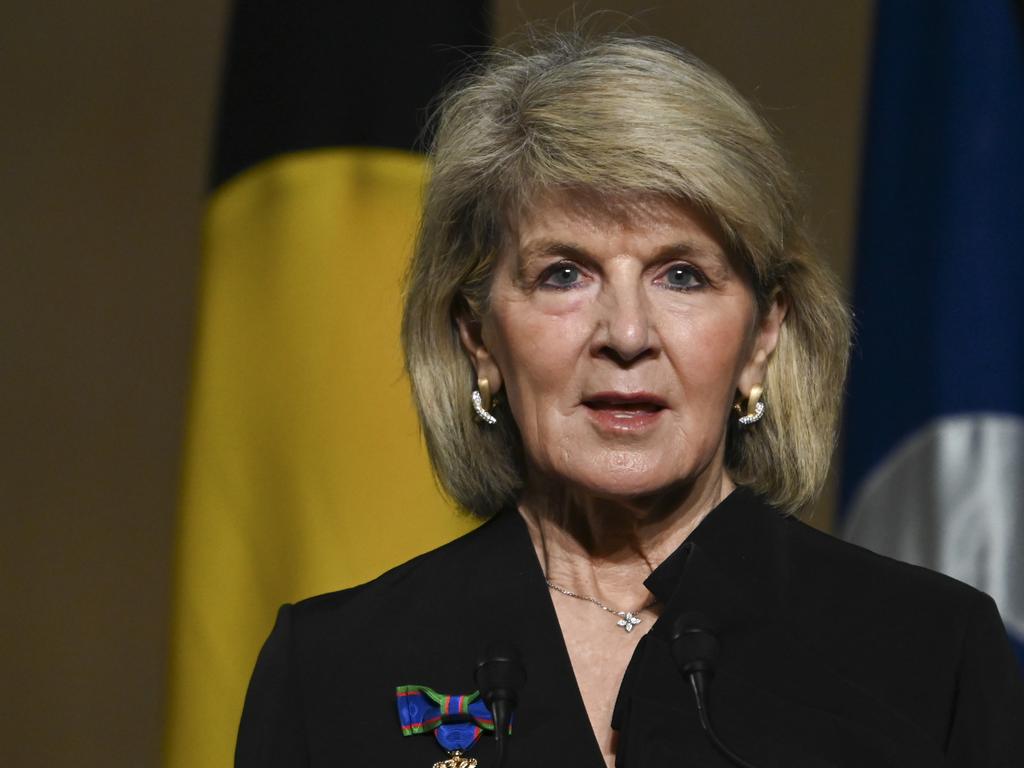
A sobbing academic has blamed her near-suicide and miscarriage on alleged bullying by Australian National University chancellor Julie Bishop, as it emerged the scandal-stricken university is being probed by a government regulator.
The Tertiary Education Quality and Standards Agency has launched a compliance assessment against the university, after students complained they were forced to sit on the floor as lecturers and entire courses vanished in a $250m cost-cutting drive.
The ANU’s dysfunction was exposed during a dramatic and distressing Senate hearing into university governance on Tuesday, when staff and students made disputed allegations of bullying, spying and third-world teaching conditions.
Liz Allen, an ANU demographer and lecturer who quit the university’s governing council in April, spoke through tears as she told senators: “I was bullied into near-suicide. I miscarried a much-wanted baby.
“I fear for my job, and my career has been derailed.’’
Dr Allen said she had written a suicide note to her children after Ms Bishop – a former deputy Liberal leader and foreign minister and now a UN envoy – wrongly accused her of leaking information to the media during a two-hour “disciplinary lecture’’ in February.
“It affected me so deeply that on the drive home I decided to kill myself,’’ Dr Allen told the hearing.
“I pulled over to write final goodbyes to my children and my partner. I emailed my supervisors so they knew I hadn’t done anything wrong. A call from my husband stopped me taking my life.’’
Dr Allen said she was pregnant at the time but “in roughly the fortnight following, my much-wanted baby died, its heart stopped beating”.

After the hearing, Ms Bishop told The Australian she disputed Dr Allen’s allegations against her.
“I reject any suggestion that I have engaged with council members, staff, students and observers in any way other than with respect, courtesy and civility,’’ Ms Bishop said. “The witness concerned has initiated grievance procedures and it is not appropriate for me to comment further at this time.’’
National Union of Students president Ashlyn Horton, a fourth-year student in mathematics and international relations at ANU, told the hearing that lecture rooms were so crowded “you can barely see the whiteboard, much less participate in their tutorials which have doubled if not tripled in size’’.
“Courses you had planned to study are no longer being offered,’’ she said. “Research students are losing supervisors to redundancy, leaving them unsupported for months, sometimes losing the only specialist in their field at university.’’
ANU Students’ Association president Will Burfoot, who is studying a Bachelor of Economics, said overcrowded lecture rooms forced students to sit on the floor.
“Students pay a lot of money to go to university, so rightly we would expect we are not expected to sit on the floor in our tutorials, and that we do have availability in what courses we take, and that we have access to our tutors,’’ he said. “Students feel betrayed.’’
AN ANU spokesman said the university was investigating students’ claims of sitting on the floor, which may relate to hail damage that changed access to some teaching rooms.
“To deliver large class experiences that are just as enriching as smaller ones, we’re developing and supporting dedicated approaches for courses with large groups, by working with conveners on developing sound pedagogy and practical alternatives to delivering large lectures and exam-based assessments,’’ he said.
Hundreds of ANU staff have been sacked in the past year as the university slashes spending by $250m.

TEQSA has raised concerns about the “competency and culture’’ of ANU’s governing council, led by Ms Bishop, and will investigate whether “members of the governing body are fit and proper persons’’.
“TEQSA is concerned ANU’s Council may not have fulfilled its obligation to exercise competent governance oversight of and be accountable for all ANU’s operations,’’ TEQSA chief executive Mary Russell wrote to vice-chancellor Genevieve Bell, in a compliance letter tabled in the Senate on Tuesday. “There are concerns about the ANU council’s oversight of ANU’s financial position.’’
Dr Russell revealed at the Senate hearing that the ANU had missed Tuesday’s deadline to provide a 10-page “self-assurance report’’, and had been granted a week’s extension.
Independent senator David Pocock said he had reported Dr Allen’s allegations in June to federal Education Minister Jason Clare, who had passed them to TEQSA.
The ANU has been rocked by revelations Professor Bell – who earned $1.46m in total remuneration last year – also pocketed nearly $70,000 for 24 hours of work last year, while moonlighting for her former employer, tech giant Intel.
Ms Bishop was forced to correct ASIC documents that had erroneously listed her chancellery office in Perth – which costs the ANU $150,000 a year to rent – as the address of her private consulting firm, Bishop & Partners.
Dr Allen spent 2½ years as one of three elected staff representatives to the ANU council, before resigning in April. In her evidence to the Senate inquiry on Tuesday, Dr Allen said Professor Bell’s paid Intel role “was never communicated to staff’’, and she had never heard it mentioned during her time on the governing council.
Dr Allen said the university had wrongly blamed US President Donald Trump’s “woke research’’ edict for the loss of hundreds of thousands of dollars in American research funding. “A colleague of mine had a very prestigious grant, and the funding ended because the ANU had failed to bill the US government,’’ she said. “But it was being communicated to the council that it was because the US leadership had decided no longer to fund these sorts of projects under the Trump government.
“That’s not true, and the university actually lost hundreds of thousands of dollars, and it caused great stress to the research area.’’
Dr Allen said the ANU council was “dysfunctional and toxic under the current regime … I believe Chancellor Bishop is hostile and arrogant to staff’.’
Dr Allen said she had hyperventilated and cried during one meeting after questioning a financial matter.
She said Ms Bishop had accused her of defamation, and Professor Bell had suggested that “I sought personal gain to leak’’.
“Chancellor Bishop laughed incredulously at my emotional response, and at one point blocked me leaving the room,’’ Dr Allen told the hearing. “I was so distressed, I couldn’t breathe and struggled to walk. I haven’t leaked and I haven’t breached the ANU code of conduct. I’ve merely tried to hold leadership accountable.’’
The Senate education committee’s chairwoman, Labor senator Marielle Smith, an ANU alumnus, said Ms Bishop and Professor Bell had been invited to appear before the hearing on Tuesday but were unable to attend.
She reserved the right to recall the ANU leaders to future hearings by the end of this year.
ANU chief operating officer Jonathan Churchill told the hearing Professor Bell was sick with the flu, and Ms Bishop was busy with duties as the UN secretary-general’s special envoy to Myanmar. He said the ANU took Dr Allen’s allegations “very seriously’’.
“On a preliminary view, a number of the statements do not appear to be correct, and we will examine all of the statements made and respond with particularity in writing to those assertions,’’ he said.
Mr Churchill said Dr Allen had lodged a complaint against the university, “which makes it impossible to comment whilst the grievance procedure is on foot without compromising those current proceedings”.
Greens higher education spokeswoman Senator Mehreen Faruqi called on Ms Bishop and Professor Bell to resign or be sacked.