
Controversy on the canvas: The works that sparked rage in Australian galleries
From vandalised projects and blood drenched works, to art purchases that ignited political powder kegs, Australian gallery spectators are leading the world in outrage.


Art has always been a provocation, but in Australia, controversy seems to cling to the canvas. From paintings that ignited political outrage to installations accused of desecration, the nation’s galleries and public spaces have long doubled as battlegrounds for debates about identity, morality, and power. Here are the works that have sparked the most ire over the decades.

Santiago Sierra’s “Union Flag” (Dark Mofo, Hobart)
In 2021, Santiago Sierra proposed soaking a British Union Jack in the blood of First Nations peoples for the Dark Mofo festival. The work was intended to confront colonial violence but was widely condemned as exploitative and insensitive. Critics argued that it re-traumatised Indigenous communities while appropriating their pain for shock value. The backlash led to the cancellation of the project, highlighting the complexities of using provocative art to address historical injustices.

The Shellal Mosaic (Australian War Memorial, Canberra)
Discovered by Australian soldiers in Palestine during World War I, this Byzantine mosaic from a 6th-century church was removed and brought to Australia amid controversy. The mosaic, now displayed at the Australian War Memorial, has been criticised as “battlefield loot.” Calls for its repatriation continue, with debates over whether it should be returned to Palestine or Israel, given the contested territory. The mosaic’s removal and display raise ethical questions about cultural heritage and the legacy of wartime acquisitions.

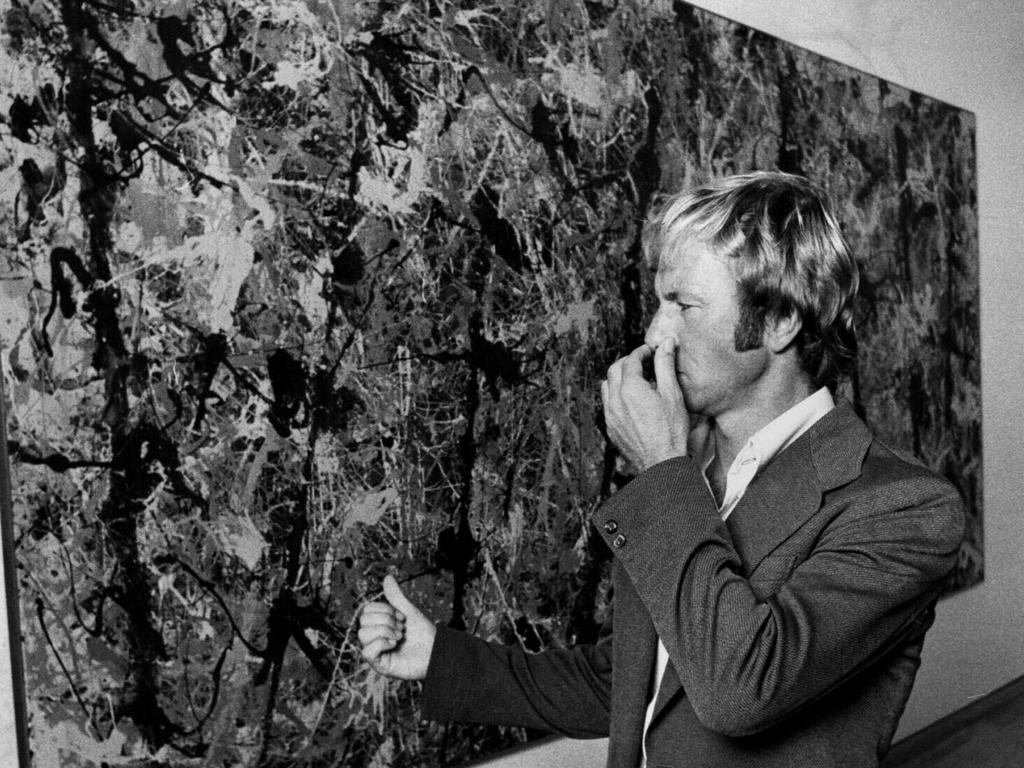
Jackson Pollock’s Blue Poles (National Gallery of Australia)
Purchased in 1973 for US$1.3 million, Number 11, 1952, best known as Blue Poles, sparked national outrage due to its abstract nature and high cost, which many Australians deemed extravagant. The acquisition became a political issue, with critics questioning its artistic merit and value. However, over time, the painting has been celebrated as a landmark in Australian cultural history, symbolising the nation’s embrace of modern art.

Juan Davila’s Burke and Wills (Various Exhibitions)
Davila’s provocative reinterpretation of Australian history, including the ill-fated Burke and Wills expedition, challenges colonial narratives and national myths in the most graphic and irreverent of ways. His works often feature confronting imagery and political commentary, sparking debates about historical representation and the role of art in critiquing national identity.

Mike Parr’s Performance Art
Known for his endurance-based performances, Parr has frequently courted controversy. His 2018 act of being buried alive under a road in Hobart was particularly divisive, with critics questioning the limits of performance art and its impact on audiences. Parr’s works often provoke discomfort, forcing viewers to confront themes of pain, mortality, and societal norms.

Andres Serrano’s “Piss Christ” (National Gallery of Victoria)
Displayed in 1997, Serrano’s photograph of a crucifix submerged in urine provoked outrage from religious groups and conservative politicians. The work was vandalised during its exhibition, reflecting the polarising nature of provocative art and the tensions between artistic expression and public sentiment.

William Dobell’s Portrait of Joshua Smith (Art Gallery of New South Wales)
Dobell’s 1943 Archibald Prize-winning portrait was criticised as a caricature rather than a true portrait, leading to a court case. The controversy highlighted the subjective nature of art and the challenges of defining artistic categories, such as portraiture.

Norman Lindsay’s nudes
Lindsay became known for his controversial nudes that blended pagan mythology with erotic themes. The frequent depictions of voluptuous female nudes in his works repeatedly sparked outrage, leading to incidents like the temporary removal of a painting from an exhibition and the burning of some of his art as “pornography” by American officials in 1940.

Ron Robertson-Swann’s “Vault” (Melbourne)
Nicknamed the “Yellow Peril,” this abstract steel sculpture faced public backlash upon its installation in 1980. Its removal and relocation underscored the difficulties of introducing avant-garde art into public spaces and the clash between public expectations and artistic innovation.

Greg Taylor’s “Liz and Phil Down by the Lake” (Canberra)
This sculpture of Queen Elizabeth II and Prince Philip depicted as naked, elderly figures caused a sensation in 1995. The work was eventually vandalised, reflecting public discomfort with irreverent portrayals of royalty and the limits of artistic freedom.

Marc Quinn’s Buck with Cigar and Patricia Piccinini’s Big Mother (Art Gallery of South Australia)
These sculptures faced calls for relocation due to their confronting themes. Buck with Cigar portrays transgender man Buck Angel, while Big Mother depicts a genetically engineered creature breastfeeding a human baby. Both works sparked debates about their appropriateness for public viewing and the role of art in addressing controversial topics.
Love culture? Sign up to our free newsletter for all the essential shows, compelling books, must-see films, and live performances that you need to know about here.
More Coverage


To join the conversation, please log in. Don't have an account? Register
Join the conversation, you are commenting as Logout