
The hotspots where Buruli ulcer is spreading across Australia: See the maps
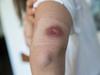
Scientists know how possums pass Buruli ulcer bacteria to people via mosquitoes. Now they have developed a tool to warn of emerging hotspots. WARNING: GRAPHIC


DNA fingerprints found in possum poo are helping to predict Buruli ulcer hotspots up to six years before the flesh-eating infection appears in people.
“Forewarned is forearmed,” said Tim Stinear, the senior author of a new study detailing the unique early-warning tool.

He said it meant researchers would not have to wait for people to become infected before knowing an area is at risk, which will help guide early public health interventions.
University of Melbourne Professor Stinear is the director of the WHO Collaborating Centre for Mycobacterium ulcerans at the Peter Doherty Institute for Infection and Immunity.
Buruli ulcer (BU) is caused by the bacterium Mycobacterium ulcerans which is carried by native possums. The Doherty team recently confirmed it was passed from possums to people by mosquito bites.

The Doherty-led team developed the early warning tool by focusing on Melbourne’s BU hotspots, including Brunswick West, Pascoe Vale South, Essendon, Moonee Ponds and Strathmore and Belmont in Geelong to see if the infections were locally acquired.
Using advanced genomics modelling, they showed how it was introduced to these areas between two to six years before the first human cases appeared locally.
Professor Stinear said BU was mainly found in Melbourne, but increasing across south eastern Australia.
Last year the first cases were reported in Batemans Bay in southern New South Wales and there have been sporodic cases in Far North Queensland in the Daintree.
The infection spreads weeks after a mosquito bite in the fat layer beneath the skin causing extensive damage if not diagnosed early.
Dr Finn Romanes is director of the Western Public Health Unit in Victoria, which has 12 known BU hot spots.
“This year alone, notifications have increased by 40 per cent in the western suburbs, with 114 cases recorded so far in 2025,” he said.
Dr Romanes said now was the time to take preventive action.

“With mosquitoes confirmed as the vector in Australia, people can protect themselves by using repellents, wearing long sleeves and avoiding mosquito bites in these hotspots,” he said.
“Mosquito numbers usually surge from November to April, and most people then develop a Buruli ulcer lesion four to five months later. GPs can diagnose the infection with a simple skin test.”
Professor Stinear said the insight from the study was that the forensic power of genomics, the DNA fingerprinting, from possum poo can identify new BU endemic areas across Australia.
“We can survey possum poo. It is not very glamorous, but it is straightforward,” he said.
“We take samples back to the lab and test them, not just for the bacteria that causes Buruli, but also to get this genomic fingerprint and match it with what’s happening in people. When we put it all together, we can see the genomic signature of new endemic areas.
“We are research scientists, but we’ve now got these tools that public health agencies could adopt to be on the front foot.”
The paper was published in the journal Applied and Environmental Microbiology.
More Coverage

Originally published as The hotspots where Buruli ulcer is spreading across Australia: See the maps
Join the conversation

Scientists’ shock revelation for everyone who’s had Covid
Read more

Science fiction to fact: Futuristic exoskeletons get patients moving again
Read more