NewsBite

Race against time as Philae probe battery runs down

EUROPE’S robot lab Philae will attempt to drill into its host comet 510 million kilometres from Earth, with just hours of on-board battery life left.
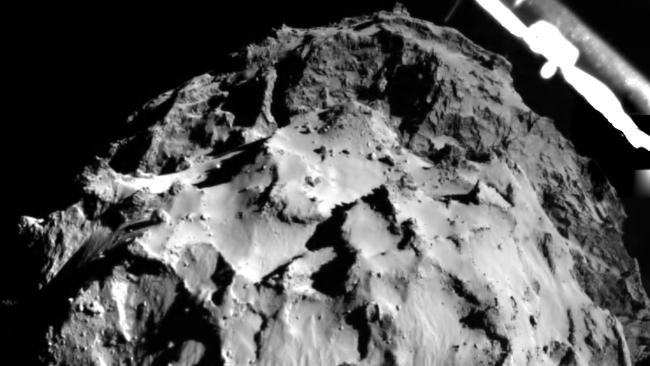
DARMSTADT, GERMANY - NOVEMBER 12: (EDITORIAL USE ONLY) This November 12, 2014 handout photo provided by the European Space Agency (ESA) shows comet 67P/CG acquired by the ROLIS instrument on the Philae lander during descent on November 12, 14:38:41 UT from a distance of approximately 3 km from the surface. The landing site is imaged with a resolution of about 3m per pixel. ROLIS (ROsetta Lander Imaging System) is a descent and close-up camera on the Philae Lander. ESA later successfully landed Philae, making it the first man-made craft to ever land on a comet. The Philae lander, launched from the Rosetta probe, is a mini laboratory that will gather data on the comet. (Photo ESA via Getty Images) *** BESTPIX ***

EUROPE’S robot lab Philae will attempt to drill into its host comet 510 million kilometres from Earth, with just hours of on-board battery life left, a mission scientist says.

The European Space Agency (ESA) “has decided to go ahead with the drill,” astrophysicist Philippe Gaudon, who heads the Rosetta mission at French space agency CNES, told AFP by telephone from Toulouse in the country’s south on Friday.

Philae, a washing machine-sized robot lab, landed on the comet on Wednesday after a nailbiting seven-hour descent from its orbiting mothership Rosetta, which had travelled more than a decade and 6.5 billion kilometres to get there.

FIRST PICTURE FROM COMET RELEASED

PROBE LANDS ON COMET IN SPACE FIRST

A handout released by the European Space Agency (ESA) on November 12, 2014 shows people celebrating in the Main Control Room at ESA's Operations Centre, ESOC, in Darmstadt, Germany, as separation of the Philae lander from ESA Rosetta orbiter is confirmed. A European probe on November 12 made the first-ever landing on a comet in a quest to explore the origins of the Solar System, but there were concerns over whether it was fastened securely enough to carry out its mission. The European Space Agency (ESA) said the robot lab, called Philae, had touched down on the comet 67P/Churyumov-Gerasimenko in a high-risk manoeuvre more than 510 million kilometres (320 million miles) from Earth. AFP PHOTO / HO / ESA - J. Mai -- RESTRICTED TO EDITORIAL USE - MANDATORY CREDIT
A handout released by the European Space Agency (ESA) on November 12, 2014 shows people celebrating in the Main Control Room at ESA's Operations Centre, ESOC, in Darmstadt, Germany, as separation of the Philae lander from ESA Rosetta orbiter is confirmed. A European probe on November 12 made the first-ever landing on a comet in a quest to explore the origins of the Solar System, but there were concerns over whether it was fastened securely enough to carry out its mission. The European Space Agency (ESA) said the robot lab, called Philae, had touched down on the comet 67P/Churyumov-Gerasimenko in a high-risk manoeuvre more than 510 million kilometres (320 million miles) from Earth. AFP PHOTO / HO / ESA - J. Mai -- RESTRICTED TO EDITORIAL USE - MANDATORY CREDIT "AFP PHOTO/ESA/J.Mai" - NO MARKETING NO ADVERTISING CAMPAIGNS - DISTRIBUTED AS A SERVICE TO CLIENTS --

The touchdown on the low-gravity comet did not go entirely according to plan, when Philae’s duo of anchoring harpoons failed to deploy and it bounced off twice.

Philae ended up in a mystery zone shadowed from sunlight. It is receiving only 1.5 hours of battery-recharging solar rays per day instead of the six or seven required.

The lab landed with only about 60 hours of on-board power before it needs to switch to solar panels to try and extend the mission duration by as much as possible.

Scientists are still trying to work out how much power Philae may still get from the limited sunlight available to it.

IN SPACE: (EDITORIAL USE ONLY) This November 13, 2014 handout photo provided by the European Space Agency (ESA) shows the surface of the 67P/Churyumov-Gerasimenko comet as seen from the Philae lander, which landed on the comet's surface yesterday. ESA, despite some malfunctions on the Philae craft, successfully landed it on the comet on November 12, 2014 making it the first man-made craft to ever land on a comet. The Philae lander, launched from the Rosetta probe, is a mini laboratory that will gather data on the comet. (Photo ESA via Getty Images) ***BESTPIX***

“The primary battery enabling the core science goals of the lander may run out some time in the next 24 hours,” said an ESA statement issued at on Friday.

“As for the secondary battery, charged by solar panels on Philae, with only 1.5 hours of sunlight available to the lander each day, there is an impact on the energy budget to conduct science for a longer period of time.”

Gaudon said that if Philae’s on-board battery runs out and its solar batteries are not charged, which could happen on Friday night, Philae won’t be dead but “in hibernation”.

Devoted ... physicist Matt Taylor shows his Rosetta tattoo at the satellite control centre of the European Space Agency in Darmstadt, Germany. Picture: AP/Arne Dedert

After its rough touchdown, it was not clear whether Philae would be able to use its drill, one of 10 on-board experiments, to take sub-surface comet samples for chemical testing.

Some feared that trying to activate the drill with the 100kg lander balanced precariously on a steep slope on the comet — which has minimal gravity — could tip it over.

Drill samples have been among the most highly anticipated results from Philae’s mission, with some hoping for clues to the formation of the Solar System and the appearance of life on Earth.

Robot lab ... an image from Rosetta’s OSIRIS narrow-angle camera shows details of the Philae lander, including the deployment of the three legs and of the antennas. Picture: ESA/Rosetta/Philae

Original URL: https://www.news.com.au/technology/science/space/race-against-time-as-philae-probe-battery-runs-down/news-story/441bd9272f079eb2f607028711727420