
NASA’s Juno spacecraft to make historic fly-by of Jupiter’s Great Red Spot today
NASA’s Juno spacecraft will make history today when it flies over Jupiter’s famous Great Red Spot - a 16,000-kilometre wide storm that has been raging for 350 years.
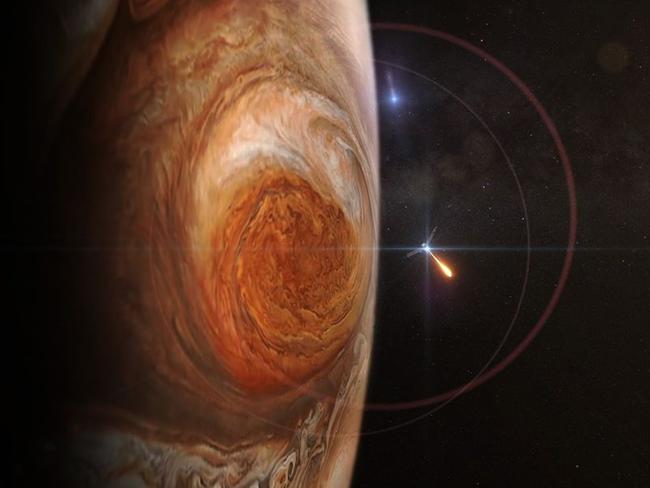
NASA’s Juno spacecraft will make history today when it flies over Jupiter’s famous Great Red Spot.
The Spot is a 16,000-kilometre wide storm that has been monitored since 1830, according to NASA. Juno’s fly-by will be humanity’s closest look at the huge feature.
The spacecraft entered Jupiter’s orbit on July 4, 2016.
“Jupiter’s mysterious Great Red Spot is probably the best-known feature of Jupiter,” said Scott Bolton, principal investigator of Juno from the Southwest Research Institute in San Antonio, in a statement.
“This monumental storm has raged on the solar system’s biggest planet for centuries. Now, Juno and her cloud-penetrating science instruments will dive in to see how deep the roots of this storm go, and help us understand how this giant storm works and what makes it so special.”
Today, our @NASAJuno craft is flying over Jupiter's Great Red Spot, kicking off a close-up study of the iconic storm https://t.co/b2KVgF7KPL pic.twitter.com/6vt7ojui63
— NASA (@NASA) July 10, 2017
Juno is expected to reach the point in its orbit closest to Jupiter’s centre at 11:55am AEST Tuesday, at which time it will be about approximately 3540 kilometres above the planet’s cloud tops. Some 11 minutes and 33 seconds later, the spacecraft will be over the vast storm, passing 9000 kilometres over the Red Spot’s cloud tops.
A spokeswoman for NASA told Fox News that raw images of Great Red Spot taken by the spacecraft’s JunoCam are expected to be downlinked and available by the weekend.
Juno celebrated its one-year-anniversary within Jupiter’s orbit on July 5, 2017 (AEST), chalking up around 114 million kilometres in orbit around the gas giant. The spacecraft has come as close as 3379 kilometres of Jupiter’s cloud tops during its fly-bys of the huge planet.

Juno launched from Cape Canaveral on August 5, 2011. Early science results from the mission portray Jupiter “as a turbulent world, with an intriguingly complex interior structure, energetic polar aurora, and huge polar cyclones,” according to NASA.
Jupiter is mostly composed of hydrogen and helium surrounding a core of rocks and ice, according to Space.com.
In recent years observations by the Hubble Space Telescope have revealed that the storm in Jupiter’s atmosphere is shrinking.
In 2015 NASA’s New Horizons spacecraft made a historic fly-by of Pluto after travelling 4.8 kilometres on an epic journey that lasted more than nine years.


