
Dutch seismologist predicted Turkey earthquake three days earlier
A Dutch seismologist correctly predicted that a powerful earthquake would happen imminently in Turkey, three days before the disaster.
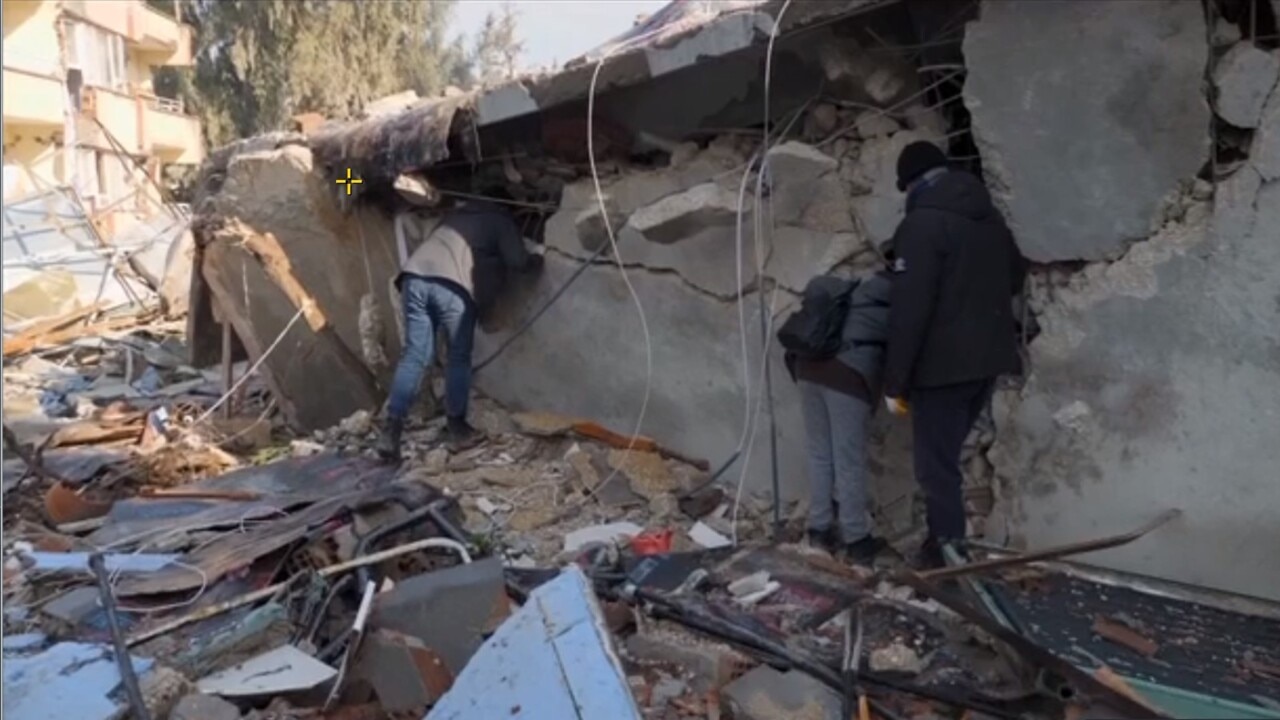
A Dutch seismologist correctly predicted that a powerful earthquake would happen imminently in Turkey, three days before the disaster that killed more than 21,000 people.
Frank Hoogerbeets from the Solar System Geometry Survey (SSGEOS) in the Netherlands made the prediction on Twitter on February 3, even attaching a map correctly marking the area where the earthquake would strike.
“Sooner or later there will be a ~M 7.5 earthquake in this region (South-Central Turkey, Jordan, Syria, Lebanon),” he wrote in a now viral tweet shared more than 51,000 times.
Sooner or later there will be a ~M 7.5 #earthquake in this region (South-Central Turkey, Jordan, Syria, Lebanon). #deprempic.twitter.com/6CcSnjJmCV
— Frank Hoogerbeets (@hogrbe) February 3, 2023
A strong earthquake struck southeastern Turkey and neighbouring Syria in the early hours of Monday, devastating cities and killing and injuring thousands.
The first 7.8 magnitude quake occurred at 4.17am local time at a depth of about 18 kilometres near the Turkish city of Gaziantep, which is home to around two million people, the US Geological Survey said.
It was followed by a slightly smaller 7.5 magnitude tremor and many aftershocks. The quakes devastated entire sections of major cities in Turkey and war-ravaged Syria.
The region also hosts millions of people who have fled the civil war in Syria and other conflicts.
More than 21,000 people have been killed and thousands more injured as efforts continue for a fourth day in freezing conditions to save those still trapped under rubble.
Reacting to the earthquake after his prediction went viral, Mr Hooogerbeets wrote, “As I stated earlier, sooner or later this would happen in this region, similar to the years 115 and 526. These earthquakes are always preceded by critical planetary geometry, as we had on 4-5 Feb.”
The planetary and lunar geometry that converged on 4-5 February. This was also discussed in the latest forecast video. pic.twitter.com/19lWd4uAKo
— SSGEOS (@ssgeos) February 6, 2023
SSGEOS describes itself on Twitter as a “research institute for monitoring geometry between celestial bodies related to seismic activity”.
After multiple aftershocks were felt in the following days, Mr Hooogerbeets wrote, “The large earthquakes in Central Turkey have caused a significant change in stress distribution throughout the region, with seismic activity down to Palestine as a result. Clearly, the region is resettling.”
Officials and medics said Thursday that 17,674 people had died in Turkey and 3377 in Syria, bringing the confirmed total to 21,051.
Initial rescue efforts were hampered by a winter storm that covered major roads in ice and snow and left three key airports in the area inoperable, complicating deliveries of vital aid.
Survivors are still being pulled from collapsed buildings, though disaster experts warn that the chances of saving lives drop sharply after 72 hours.
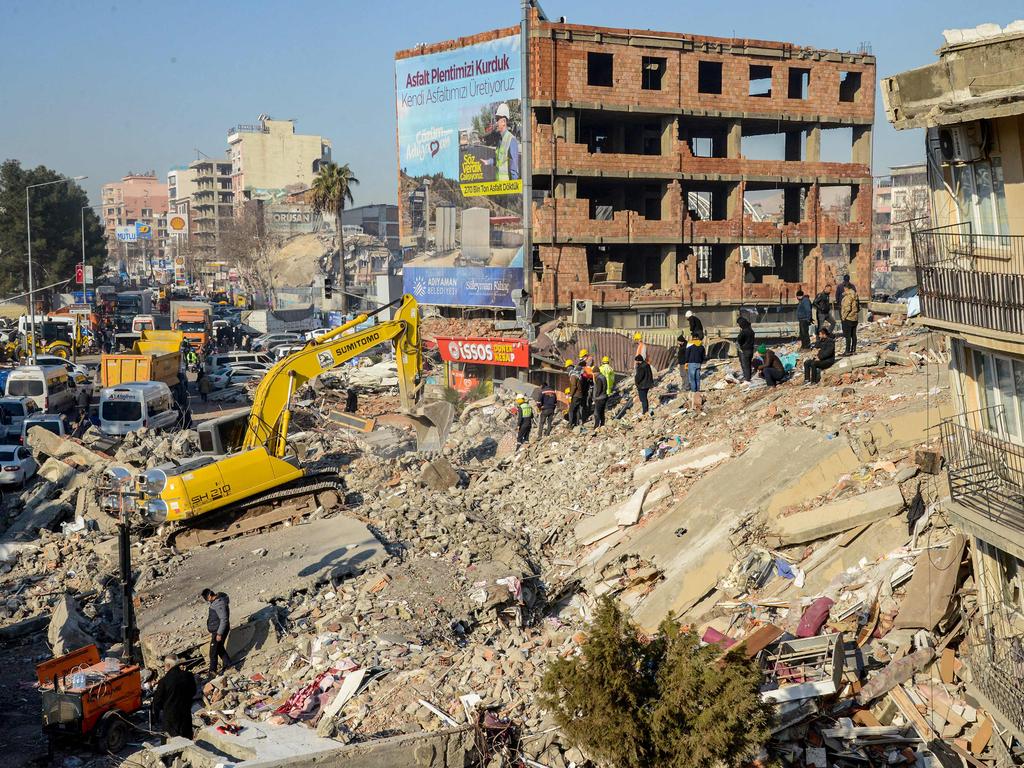
Some of the heaviest devastation occurred near the quake’s epicentre between Kahramanmaras and Gaziantep, where entire city blocks lay in ruins.
Turkey said almost 3000 buildings had collapsed in seven different provinces, including public hospitals.
A famous mosque dating back to the 13th century partially collapsed in the province of Maltaya, where a 14-storey building with 28 apartments that housed 92 people collapsed.
Social media posts showed a 2200-year-old hilltop castle built by Roman armies in Gaziantep lying in ruins, its walls partially turned to rubble.
In Syria, the health ministry reported damage across the provinces of Aleppo, Latakia, Hama and Tartus, where Russia is leasing a naval facility.
The UN’s cultural body UNESCO warned that two sites on its World Heritage List, the old city of Syria’s Aleppo and the fortress in the southeastern Turkish city of Diyarbakir, had sustained damage and that several others may also have been hit.
It noted that the quake occurred in one of the longest continuously inhabited areas on the planet within the so-called Fertile Crescent, which has witnessed the emergence of different civilisations from the Hittites to the Ottomans.
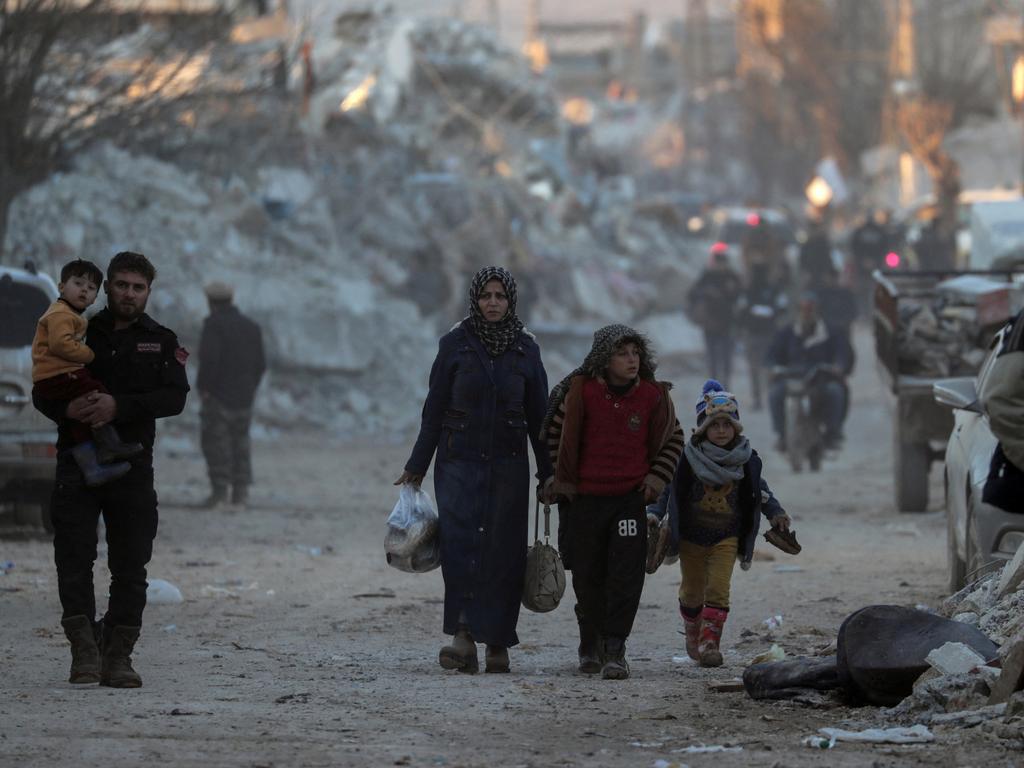
Even before the tragedy, buildings in Aleppo often toppled due to poor infrastructure and many are dilapidated after more than a decade of war.
Large parts of Antakya in south-central Turkey — once the ancient city of Antioch — have been reduced to rubble.
The Syrian village of Tloul was flooded when a mud dam collapsed, leaving families to flee water that submerged houses, streets and crop fields.
Ratings agency Fitch said the quake could cause economic losses exceeding $US4 billion ($5.8 billion). Insured losses will be much lower, possibly around $US1 billion ($1.5 billion), due to low insurance coverage in the area, it added.
Condolences and offers of aid have poured in, including from the European Union, the United Nations, NATO, Washington, China and Russia.
The UN insisted Thursday on the need to avoid “politicisation” of aid to earthquake victims in Syria, which faces international sanctions, and urged Washington and Brussels to ensure there were “no impediments”.
EU chief Ursula von der Leyen said the bloc is planning to host a donor conference in March.

President Joe Biden promised his Turkish counterpart Recep Tayyip Erdogan that the United States will send “any and all” aid needed.
US Secretary of State Antony Blinken said Washington would work with partners to provide aid in Syria, instead of with the government of President Bashar al-Assad — which is under Western sanctions over alleged humanitarian abuses during his country’s nearly 12-year civil war.
Syria, which has only been offered minimal assistance because of the sanctions, on Wednesday made an official plea to the EU for help.
An aid convoy reached rebel-held northwestern Syria Thursday, the first since the earthquake, an official at the Bab al-Hawa border crossing told AFP.
France meanwhile pledged 12 million euros ($18.6 million) in emergency aid to Syria.
The UN’s resident Syria coordinator, El-Mostafa Benlamlih, called for the facilitation of aid access to rebel-held areas in Syria’s northwest, warning that relief stocks will soon be depleted.
The European Commission is “encouraging” EU member countries to respond to Syria’s request for medical supplies and food, said the commissioner, Janez Lenarcic.


The World Health Organisation said up to 23 million people overall could be affected by the earthquake and promised long-term assistance.
WHO chief Tedros Adhanom Ghebreyesus said 77 national and 13 international emergency medical teams were deploying to the affected areas.
And the World Bank said on Thursday that it would provide Turkey with $US1.78 billion ($2.57 billion) to help relief and recovery efforts.


