
Andrew Potts: Why the demolition of old buildings is a painful loss for Gold Coast
As the wrecking ball looms over Marina Mirage, the Gold Coast faces fresh questions about how it values the buildings that shaped its identity and its history, writes Andrew Potts.

All things end.
Buildings, like civilisations, rise and fall, and even the great rulers, like the common man, are destined to be forgotten.
Percy Bysshe Shelley made that point more than two centuries ago with the sonnet Ozymandias, noting the inevitability of time.
Our lives are fleeting and George Harrison was right when he sang 55 years ago that all things must pass.
The Gold Coast is set to witness another passing in coming weeks as the closure and demolition of Marina Mirage occurs.

The shopping centre has been a landmark on The Spit for nearly 40 years and, for better or worse, a reminder of the excesses of the wild 1980s and a symbol of the dramatic changes which this city experienced in that era.
Built by Christopher Skase, it was once a favourite shopping destination of the rich and famous, alongside its top restaurants where deals were done.
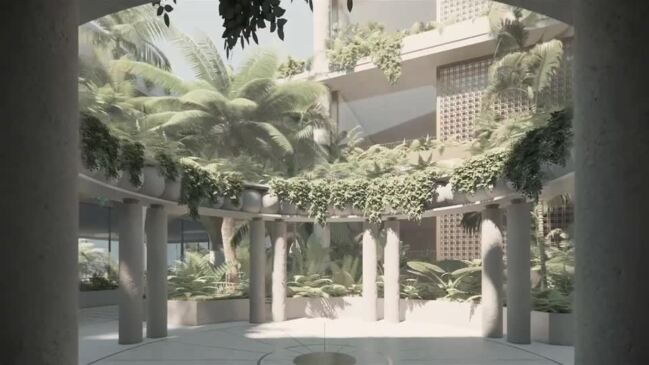
Now, it will be demolished to make way for a $500m redevelopment by its long-time owner, Makris Group, into a mixed-use hotel, retail and dining precinct.
The famous sails, which became its best-known contribution to the city’s skyline, will be retained in the design of the new building, which is expected to open in 2029.

There’s often a bittersweet feeling when buildings are demolished.
While it’s exciting to see something new rise, there’s a sense of sadness at the loss of something from the past.
The Gold Coast, and southeast Queensland as a whole, has a notorious reputation for demolishing its own history.
From the illegal destruction of Brisbane’s Cloudlands in 1982 by the Deen brothers to the losses of our own Fisherman’s Wharf, the Surfers Paradise Hotel and The Playroom, some of our favourite places of the past are now nothing but memories and the occasional saved fixture which pops up every few years.

This is hardly a new observation and thankfully, there has been a concerted effort in recent decades to preserve key Coast buildings such as Kinkabool, the first high-rise.
This process of loss and renewal is something all cities experience.
London, for example, has been home to some of the world’s great buildings but even it has endured the loss of some of its famous landmarks.
East India House, the headquarters of the famed East India Company was one of the great buildings of its era.
It was demolished in the 1860s following the wind-up of the company and today, the land is home to the famous Lloyds building, the “inside-out” building which is a modern architectural marvel in its own right which retained a century-old facade from the building it replaced.

Everything old is new again, while some of the magnificent fixtures of the 19th-century building have been retained and exist today.
The same cannot be said for those buildings here on the Gold Coast which disappeared under the weight of a wrecking ball.
The Gold Coast, unlike other cities, does not have a well-funded civic museum to tell its own history and be a repository of relics from its past.
Make no mistake, for a young city we have a rich heritage.
However, without this kind of archival collection, not only to tell that story but to make it tangible and coherent for future generations, we are destined to continue being a city which people wrongly think of as lacking history, culture or heritage.

There’s been little interest in the concept from political leaders to make it a reality but as we evolve into a modern city, this should change.
History is valuable.
It’s been said that what we leave behind is not as important as how we lived and there’s certainly logic to this.
But it is important to leave something behind.
Beyond the physical loss of old buildings, what people mourn is the loss of the places where they made memories, both happy and sad.
It is a reminder of the ticking clock we have in all our lives as we age and time fades away.
As a young city watching the gradual disappearance of many buildings from its early heydays, this feeling is acute.
The word nostalgia directly translates from Greek as “the pain of an old wound”, described once as “a twinge in your heart, far more powerful than memory alone”.
We all have nostalgia attached to these places.
For me, Marina Mirage was the location where my family was intact and together for one of the final times, having dinner at the now long-closed Ristorante Fellini many years ago.
The restaurant, the family of my youth, and soon the building will be gone but the memories will always endure.
More Coverage


‘A huge loss’: The real cost of Neighbours’ end
