Dr Richard Harris says rescuing boys trapped in flooded Thai cave ‘felt like euthanasia’
When Dr Richard Harris submerged the first of 12 unconscious children he would later help to successfully rescue from a flooded Thailand cave, he wondered if the diving mask would fill up with water.
In a raw account of the dramatic rescue of 12 kids and their coach stranded in a cave in Thailand, hero Dr Richard Harris has described how “it felt like euthanasia” when he submerged the face of the first unconscious child to test the full face mask that would be used in the operation.
“I can’t even begin to tell you, and without getting emotional about it, how that feels to push a child’s face under water when you have just given him an anaesthetic drug and wondering whether the mask will fill up with water.”
“Honestly it felt like euthanasia for the first day, I thought, ‘what the hell am I doing there’.
“But the story has a good outcome,” the Australian of the Year and South Australian of the Year said.
And it is this heartfelt, difficult to express emotion Advertiser artist Jos Valdman will seek to capture when he paints the Australian and the South Australian of the Year for the prestigious Archibald Prize.
Dr Harris and Valdman met last week for the first time to discuss the project, which grew out of a mutual respect for each other’s work.
They also were surprised to discover they had much in common; Valdman, for instance, was previously a commercial diver.
Valdman said he hoped the work, which would focus on the enormous challenge Dr Harris faced, would transcend words: “I guess the aim of any artist is to try and capture the soul of the subject, which is what I will be trying to do.”
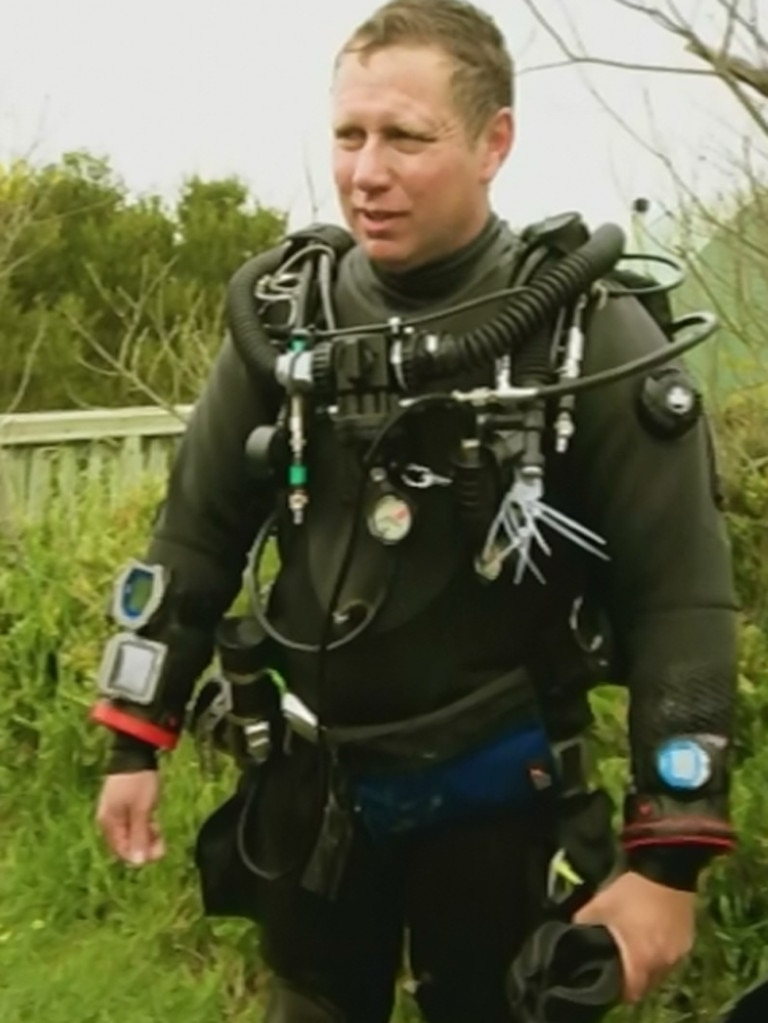
Dr Harris was one of 14 cave divers and thousands of medical and other volunteers who helped with the rescue of the Wild Boars soccer team and their coach who were found alive nine days after their disappearance in the treacherous Tham Luang cave in the remote northern Thai border town of Mae Sai. The boys spent 17 days in the cave.
Dr Harris, who shared a photo of the moment, was a speaker at a charity event to raise funds for Adelaide’s Operation Flinders, an organisation that supports disadvantaged youth.
He also shared text messages he had exchanged with another rescue hero Richard Stanton, who had first initiated the idea of sedating the stranded children to bring them out of the cave.
“My message back to him was basically ‘absolutely not, sedation is not an option’.
“He rang me a couple of hours later when I was in the operation theatre (at Flinders Hospital in SA), and we had a chat around this idea.
“You might think now obviously sedation is an option, it was greatly successful. But there’s two clear reasons to me why this just could not work. One was as a cave diver and one was as an anaesthetist.


“The idea of giving someone a general anaesthetic and then submerging them in zero visibility water, handing them over to a lay person, another caver diver, and asking them to spend three hours under water with them through the cave, I could think of literally a hundred ways they could die.
“But I couldn’t think of a single way of how this could possibly be successful.”
“So I just said, ‘no’. It cannot happen, but I am happy to come over if you think there is a role we could play.”
When Dr Harris and his friend retired Perth vet Craig Challen arrived at the Chiang Rai Airport, he took a photograph of the Thai Navy pushing a coffin into the back of an aircraft.
“It was the body of former Thai Navy Saman Gunan, who worked in security at the same airport, had retired from the navy some 12 months ago and had done no diving in that time and came back to volunteer (in the cave rescue) and drowned far into the cave trying to move equipment through the cave.

“I thought I was off on a great adventure. Suddenly this seemed a bit more serious. That was a moment to take a pause and re-evaluate my enthusiasm,” Dr Harris said.
In a presentation that lasted just over 50 minutes, Dr Harris shared the incredible diplomatic, natural and psychological challenges facing the rescue heroes, including the 14 cave divers.
There were close to 10,000 people in around the cave and in the mountains while the rescue operation was underway with all options being given a go — including the draining of the aquifers, the pumping out of water from the cave entrance and diversion of waterways to keep the levels of water in the cave under control.
There were also offers of help from around the world, including from US entrepreneur Elon Musk.
“For whatever reason, he donated a rocket component from SpaceX, a hi-tech titanium pod, which he thought could be taken and you put a child inside it and then you swim the pod out.
“But he hadn’t thought about the life-support systems that might be required for a six-hour swim dive.
“It’s all very well to put the kids inside the box, but they probably need some oxygen to breathe.
“Elon went back to the drawing board, stuck some weight belts and a scuba tank and said, ‘here you go, problem solved’.
“But really, it was a very unrealistic thing. But it did provide some amusement and good on him for having a go.”
In the end it came down to just two options — leaving the boys in the cave for six to seven months or bringing them out as soon as possible.
“Chances of them surviving in that environment both physically and psychologically would be a million to one.

“They were already starting to get chest infections and slightly soggy rotten feet.
“We thought of every possible way we could guide the kids out without anaesthetising them.
“It became very clear early on that you just cannot expect someone to go through a three-hour cave dive, in zero visibility, poke them through tiny restrictions, pushing them through holes without them panicking and dying and more importantly, from a rescue point of view, without them killing or drowning one of the rescue divers.”
Ketamine was administered to the kids — on advice from a friend in Adelaide who works with the MedSTAR emergency services and had previously seen its affect on a seal that had jumped back into the sea after being given the drug, but before losing consciousness.
“I called him and said ‘I am looking for inspiration, any thoughts’,” Dr Harris said.
“And he said, ‘remember the seal that I gave ketamine to, that was absolutely fine, why don’t you do that.”

Ketamine was determined to be an excellent choice because of its effect on blood pressure, among other things.
Dr Harris administered the main dose, which would last for 45 minutes, and trained the other divers to administer the top-up shots to the child as they swam through the cave.
When the rescue plan was approved by Thai authorities, Dr Harris realised his responsibility in the whole mission.
“I started to realise I was kind of being held out as the guy who the plan belonged to and I had some concerns about that given that I had zero confidence in the success of the plan.”
I was kind of being held out as the guy who the plan belonged to
“One thing that I am proud of from a personal perspective with this whole rescue is the fact that I committed to this plan and agreed to undertake something that I thought was impossible and that was doomed to fail.


“But in the absence of any other possible plan and with the idea that these kids were going to die a slow lingering horrible death, I decided to commit to providing this anaesthesia.
Dr Harris told The Advertiser he went into ‘work mode’ once he had made the decision to go with the plan to sedate the kids.
“I guess I just went into that zone personally and did what I had to do.”
But he said the rescue, described around the world as a miracle, would only have been possible because of team work.
Battle to save animals on the brink at Outback reserve